

In this day and age of global competition, it is crucial for every company to provide a product or a service that stands out from its competitors. In several cases, this tends to ensure that the product from one company is not compatible with that of another company, thereby creating dependency for the customer on a single vendor.
Moving across to Electric Vehicles (EV) infrastructure, several automotive players have been forced to collaborate with the aim of ensuring that their individual market prospects and the market as a whole improve. Numerous partnerships have taken place in the EV charging infrastructure segment across major EV markets. Network operators are coming together and signing roaming interoperability, or ‘eRoaming’ agreements to make EVs more practical and affordable.
Interoperability pacts allow an EV user to use various charging networks irrespective of the charging network ownership, through the membership of one operator. While standards for physical charging plugs, such as CHaDEMO, CCS, and GT/B, have been formulated, interoperability is primarily bringing together backend communication as well as payment and information sharing.
 The main purpose of ensuring interoperability is to address the biggest impediment to a steady growth in EV adoption that is access to a charging point. An increase in the range of an EV will certainly reduce the frequency of charging points; however, to witness higher adoption of EVs, it is necessary that the environment (charging infrastructure) supporting EVs grows at a much faster pace as a means of a market “pull” for EVs. A limited number of EV charging points will always be a concern for the current as well as potential customers of EVs. The above case for interoperability immediately increases the number of charging points available to a user as against a user using charging points from a single operator. By having a membership of a single charging operator, which has signed interoperability agreements with multiple other operators, the driver can use that one membership to locate, access, and pay for EV charging stations of various networks through one app or one RFID card. It also improves the overall user experience by offering more consistent service levels, easier billing management through one invoice for all charging, and better financial transaction security.
 EVgo announced a massive expansion of roaming access to public chargers for EVgo customers across the US, with bilateral interoperability agreements with ChargePoint and EV Connect. EVgo customers will have access to the more than 400 fast-charging stations operated by these networks, in addition to 750 EVgo DCFC stations across the US.
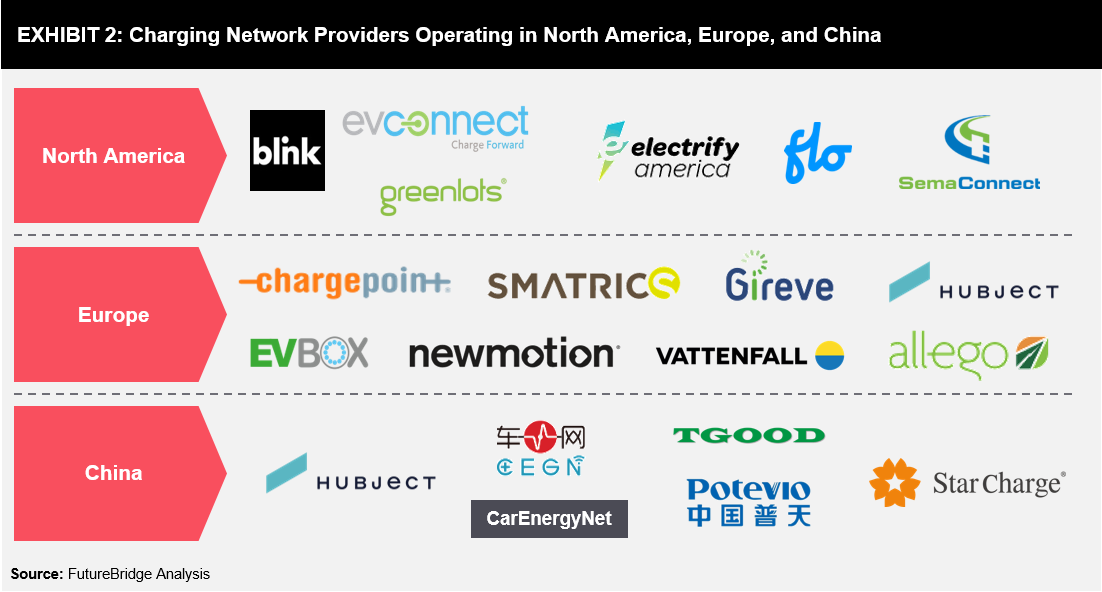
ChargePoint is collaborating with FLO to offer its customers combined access to around 33,000 public charging stations. The company also entered into a similar agreement with Greenlots and EVBox to seamlessly access public charging spots while traveling through Europe and North America.
The Austrian charging station operator, Smatrics, expanded its European roaming network in cooperation with Enel X. With this collaboration, users can gain access to 4,000 charging points in Italy and 1,900 EnBW chargers in Germany.
Electrify America (a Volkswagen subsidiary) has signed network Interoperability Agreements with other EV network providers, including EV Connect, Greenlots, and SemaConnect. Blink and Hubject are also working together in a strategic partnership for expanded charging coverage.
Hubject is an eRoaming charging platform established in 2012 by BMW, Bosch, Daimler, EnBW, Innogy, and Siemens. Started in Europe in 2012, Hubject began operations in the US last year and presently has over 300 members and 90,000 charging points connected to Hubject’s platform. Some of the other eRoaming platforms operating in Europe include Gireve and e-clearing.net, and evRoaming4EU.
EVgo announced a massive expansion of roaming access to public chargers for EVgo customers across the US, with bilateral interoperability agreements with ChargePoint and EV Connect. EVgo customers will have access to the more than 400 fast-charging stations operated by these networks, in addition to 750 EVgo DCFC stations across the US.
ChargePoint is collaborating with FLO to offer its customers combined access to around 33,000 public charging stations. The company also entered into a similar agreement with Greenlots and EVBox to seamlessly access public charging spots while traveling through Europe and North America.
The Austrian charging station operator, Smatrics, expanded its European roaming network in cooperation with Enel X. With this collaboration, users can gain access to 4,000 charging points in Italy and 1,900 EnBW chargers in Germany.
Electrify America (a Volkswagen subsidiary) has signed network Interoperability Agreements with other EV network providers, including EV Connect, Greenlots, and SemaConnect. Blink and Hubject are also working together in a strategic partnership for expanded charging coverage.
Hubject is an eRoaming charging platform established in 2012 by BMW, Bosch, Daimler, EnBW, Innogy, and Siemens. Started in Europe in 2012, Hubject began operations in the US last year and presently has over 300 members and 90,000 charging points connected to Hubject’s platform. Some of the other eRoaming platforms operating in Europe include Gireve and e-clearing.net, and evRoaming4EU.
Roaming Agreement in EV Charging
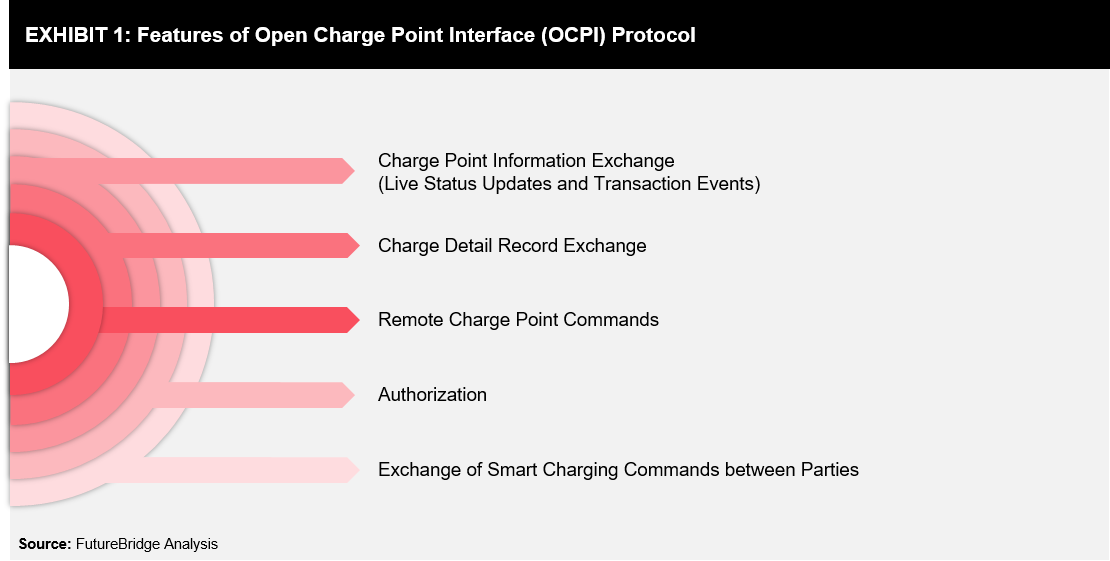
Roaming Agreements are based on the Open Charge Point Interface (OCPI) protocol that enables network operators to exchange key information needed to share charging stations with each other’s customers, thereby providing choice and flexibility to use any network on any charge station. Open Charge Point Interface (OCPI) Protocol is a language for communication between a networked charging station and a network management system to enable an automated EV roaming setup between Charge Point Operators and e-Mobility Service Providers. The OCPI was established as an initiative by the Open Charge Point Protocol (OCPP) Forum led by the E-Laad foundation. The protocol is available free of cost from the website of the Open Charge Alliance, without any licensing/royalty obligations or usage restriction. Features of Open Charge Point Interface (OCPI) Protocol are presented below in Exhibit 1.
The main purpose of ensuring interoperability is to address the biggest impediment to a steady growth in EV adoption that is access to a charging point. An increase in the range of an EV will certainly reduce the frequency of charging points; however, to witness higher adoption of EVs, it is necessary that the environment (charging infrastructure) supporting EVs grows at a much faster pace as a means of a market “pull” for EVs. A limited number of EV charging points will always be a concern for the current as well as potential customers of EVs. The above case for interoperability immediately increases the number of charging points available to a user as against a user using charging points from a single operator. By having a membership of a single charging operator, which has signed interoperability agreements with multiple other operators, the driver can use that one membership to locate, access, and pay for EV charging stations of various networks through one app or one RFID card. It also improves the overall user experience by offering more consistent service levels, easier billing management through one invoice for all charging, and better financial transaction security.
Strategies of EV Charging Network Providers
Realizing the necessity for economies of scale to install and expand across geographies with a higher density of stations, the electric vehicle charging network providers are focusing on strategic partnerships with other network providers to provide maximum geographical coverage to their customers. They are also helping customers reduce waiting time and demand incentive rates through these partnerships. Improvement in services, user interface, and access to other networks have increased customer retention for service providers.
EVgo announced a massive expansion of roaming access to public chargers for EVgo customers across the US, with bilateral interoperability agreements with ChargePoint and EV Connect. EVgo customers will have access to the more than 400 fast-charging stations operated by these networks, in addition to 750 EVgo DCFC stations across the US.
ChargePoint is collaborating with FLO to offer its customers combined access to around 33,000 public charging stations. The company also entered into a similar agreement with Greenlots and EVBox to seamlessly access public charging spots while traveling through Europe and North America.
The Austrian charging station operator, Smatrics, expanded its European roaming network in cooperation with Enel X. With this collaboration, users can gain access to 4,000 charging points in Italy and 1,900 EnBW chargers in Germany.
Electrify America (a Volkswagen subsidiary) has signed network Interoperability Agreements with other EV network providers, including EV Connect, Greenlots, and SemaConnect. Blink and Hubject are also working together in a strategic partnership for expanded charging coverage.
Hubject is an eRoaming charging platform established in 2012 by BMW, Bosch, Daimler, EnBW, Innogy, and Siemens. Started in Europe in 2012, Hubject began operations in the US last year and presently has over 300 members and 90,000 charging points connected to Hubject’s platform. Some of the other eRoaming platforms operating in Europe include Gireve and e-clearing.net, and evRoaming4EU.