

Article
Upcoming Digital Technologies – Impact on the Transmission & Distribution sector
Energy
Transmission and distribution (T&D) of electricity have evolved step by step in more than 100 years. The current use of digital technologies for the construction, maintenance, and monitoring provide huge opportunities to build cost-effective, efficient, and more reliable T&D lines. We are also on the verge of a transformation in the digitalization of energy systems with the rise of various technologies including Blockchain, Artificial Intelligence (AI), IoT, Big Data analytics, etc. Advances in digital technologies in the last 20 years have influenced the T&D industry’s modernization efforts, for example by the addition of intelligent electronic devices (IEDs) and internet connections allowing interoperability and communication between connected devices.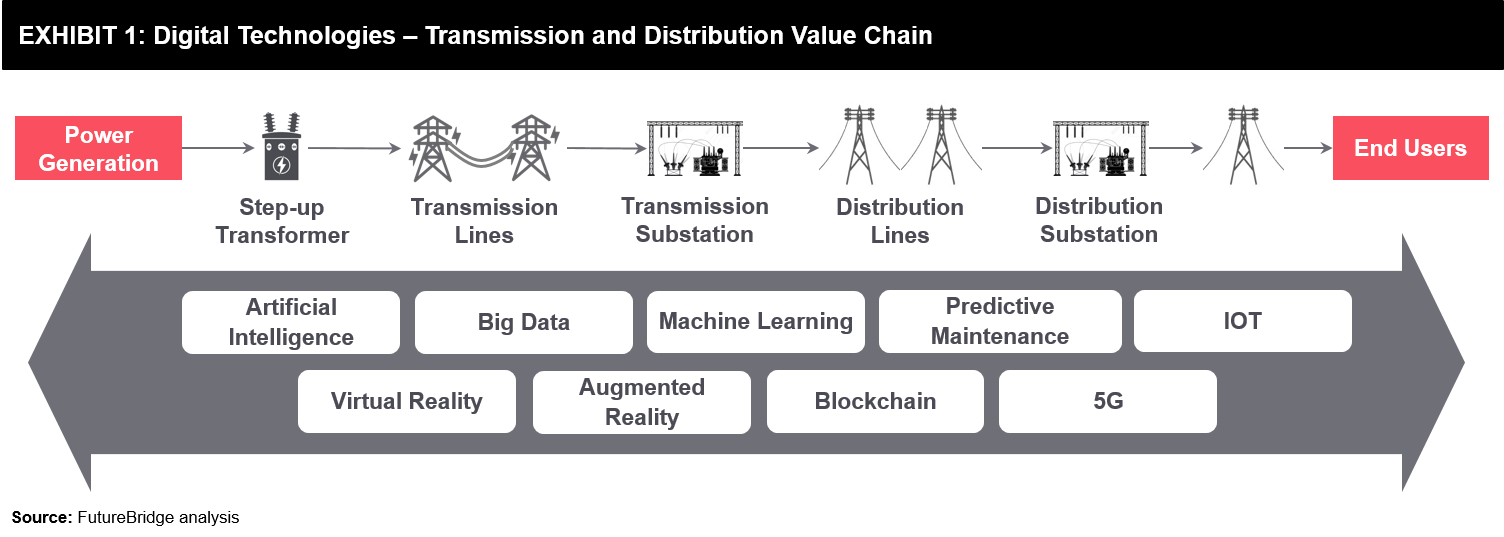
 Artificial Intelligence
-based systems can use large amounts of weather data to optimally utilize power grids to increase their capacity. It can result in better use of existing lines as a function of weather conditions. AI can also improve safety, reliability, and efficiency in the power grid system.
Application: AI-based data analysis, Inspection, and monitoring of T&D lines using AI-powered drones, AI-based monitoring sensors, etc.
Advantages: Grid stability, Minimizing investments, Power Grid Optimization
Case example: Xcel Energy, eSmart Systems, and EDM International have announced an AI-based collaborative intelligence project to transform the inspection of the transmission grid. Xcel will implement eSmart’s AI-based analytics platform to analyze imagery data of transmission assets.
KIT is also working on AI-based self-learning sensor networks to model the cooling effect of weather based on real data. This sensor network can help in weather-dependent monitoring of transmission lines for better operational efficiency.
Digital Twin
The United States has more than 54,000 substations and the average age of the transformers in these substations is 38 to 40 years. These substations need to be refurbished, retrofitted, or upgraded in due time to avoid outages. Similar is the situation in several other countries due to aging substations. Utilities can make the digital twin of these substations perform O&M activities more efficiently and cost-effectively.
Application: Digital twin for operations & maintenance, design of substations & T&D lines
Case example: In the past, planning for future grid investments at Fingrid took 80% of effort on data collection and verification and 20% on actual analysis. The Electrical Digital Twin from Siemens enabled Fingrid to save time and money that was originally spent to manually maintain a model. The data collection and verification process now takes no more than 20% of the time, while 80% remains for the crucial analysis task.
Augmented & Virtual Reality
Engineers are equipped with the AR/VR goggles that can be used to conduct a virtual site visit. This can be achieved by entering a station and interacting with stakeholders remotely through web streaming and can help in performing various designing activities.
Application: Virtual visit and remote entrance to the site
Advantages: Substation design using VR modeling, Maintenance and construction activities based on utility 3D scanning and design
Case example: Miluo Western 220kV substation project used VR modeling using UAVs, integrated BIM+geospatial, and construction simulation to complete the construction and maintenance activities of the substation. The area occupied by substation was reduced by 22% resulting in financial savings and avoiding demolition of residential properties. The project was one of the first projects to apply the 3D standards mandated for the utility industry in China.
Machine learning
A machine learning algorithm can help in predicting the failure model of a distribution feeder element. It can use data inputs like SCADA events, power quality data, GIS data, maintenance, and inspection work to analyze and predict the failure. Machine learning can also help in the creation of new intelligent BIM (Building Information Modelling) models. Digital technology using machine learning to semi-automate the process to create intelligent BIMs are being experimented
Artificial Intelligence
Artificial Intelligence-based systems can use large amounts of weather data to optimally utilize power grids to increase their capacity. It can result in better use of existing lines as a function of weather conditions. AI can also improve safety, reliability, and efficiency in the power grid system.
Application: AI-based data analysis, Inspection, and monitoring of T&D lines using AI-powered drones, AI-based monitoring sensors, etc.
Advantages: Grid stability, Minimizing investments, Power Grid Optimization
Case example: Xcel Energy, eSmart Systems, and EDM International have announced an AI-based collaborative intelligence project to transform the inspection of the transmission grid. Xcel will implement eSmart’s AI-based analytics platform to analyze imagery data of transmission assets.
KIT is also working on AI-based self-learning sensor networks to model the cooling effect of weather based on real data. This sensor network can help in weather-dependent monitoring of transmission lines for better operational efficiency.
Digital Twin
The United States has more than 54,000 substations and the average age of the transformers in these substations is 38 to 40 years. These substations need to be refurbished, retrofitted, or upgraded in due time to avoid outages. Similar is the situation in several other countries due to aging substations. Utilities can make the digital twin of these substations perform O&M activities more efficiently and cost-effectively.
Application: Digital twin for operations & maintenance, design of substations & T&D lines
Case example: In the past, planning for future grid investments at Fingrid took 80% of effort on data collection and verification and 20% on actual analysis. The Electrical Digital Twin from Siemens enabled Fingrid to save time and money that was originally spent to manually maintain a model. The data collection and verification process now takes no more than 20% of the time, while 80% remains for the crucial analysis task.
Augmented & Virtual Reality
Engineers are equipped with the AR/VR goggles that can be used to conduct a virtual site visit. This can be achieved by entering a station and interacting with stakeholders remotely through web streaming and can help in performing various designing activities.
Application: Virtual visit and remote entrance to the site
Advantages: Substation design using VR modeling, Maintenance and construction activities based on utility 3D scanning and design
Case example: Miluo Western 220kV substation project used VR modeling using UAVs, integrated BIM+geospatial, and construction simulation to complete the construction and maintenance activities of the substation. The area occupied by substation was reduced by 22% resulting in financial savings and avoiding demolition of residential properties. The project was one of the first projects to apply the 3D standards mandated for the utility industry in China.
Machine learning
A machine learning algorithm can help in predicting the failure model of a distribution feeder element. It can use data inputs like SCADA events, power quality data, GIS data, maintenance, and inspection work to analyze and predict the failure. Machine learning can also help in the creation of new intelligent BIM (Building Information Modelling) models. Digital technology using machine learning to semi-automate the process to create intelligent BIMs are being experimented
Key Challenges faced by the T&D industry
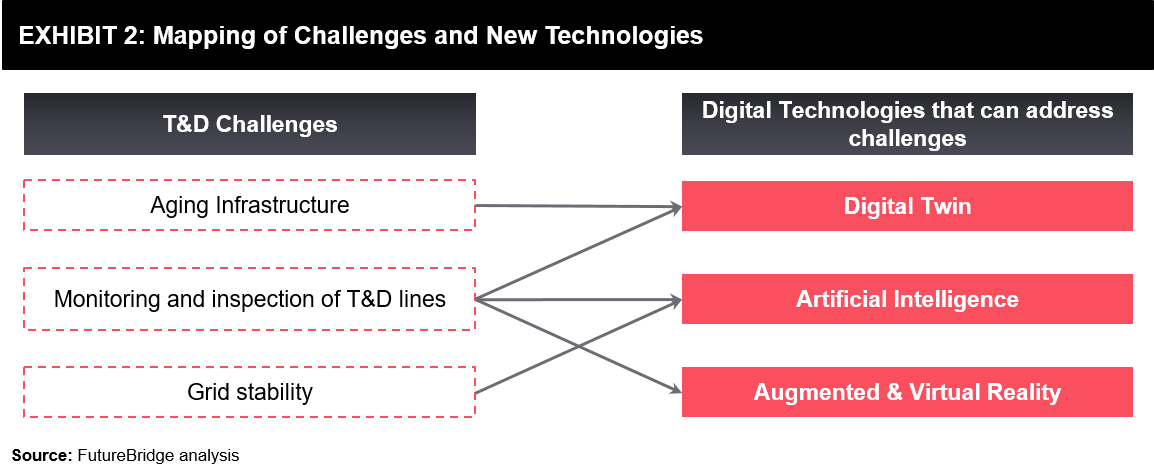
Aging Infrastructure The existing electric power delivery system in several countries relies on an aging transmission and distribution infrastructure. This infrastructure reflects technology development that has happened in the 1950s which also struggles to meet today’s growing demand. Around 40% to 45% of T&D assets either currently need or will soon need replacement which will require a huge amount of investments on both the transmission and distribution front. Monitoring and inspection of T&D lines Overhead T&D lines are among the electric power utilities’ most widely dispersed assets. These T&D lines traverse several miles even through remote areas which make monitoring and inspection activity a very challenging task for utilities. Historical inspection techniques involve inspection crews traveling to these T&D lines location to inspect in case of fault detection or scheduled inspection once or twice a year. Even though this is a critical job from the utility’s perspective, it can become a time consuming and costly activity. Grid Stability The proliferation of renewable energy and remote generation has led to several challenges to the power grid including grid stability. The intermittent nature of renewable energies like wind energy results in a major task for grid operators to provide a steady flow of electric power to consumers. It has also resulted in a higher load on the grid infrastructure and operation closer to grid stability limits.Digital technologies
New-age digital technologies can help solve challenges that are faced by T&D industries. These technologies have been adopted by some of the utilities across the world and are being used in different applications. The following are some of the examples of digital technologies that can resolve challenges faced by the T&D sector.
Artificial Intelligence
Artificial Intelligence-based systems can use large amounts of weather data to optimally utilize power grids to increase their capacity. It can result in better use of existing lines as a function of weather conditions. AI can also improve safety, reliability, and efficiency in the power grid system.
Application: AI-based data analysis, Inspection, and monitoring of T&D lines using AI-powered drones, AI-based monitoring sensors, etc.
Advantages: Grid stability, Minimizing investments, Power Grid Optimization
Case example: Xcel Energy, eSmart Systems, and EDM International have announced an AI-based collaborative intelligence project to transform the inspection of the transmission grid. Xcel will implement eSmart’s AI-based analytics platform to analyze imagery data of transmission assets.
KIT is also working on AI-based self-learning sensor networks to model the cooling effect of weather based on real data. This sensor network can help in weather-dependent monitoring of transmission lines for better operational efficiency.
Digital Twin
The United States has more than 54,000 substations and the average age of the transformers in these substations is 38 to 40 years. These substations need to be refurbished, retrofitted, or upgraded in due time to avoid outages. Similar is the situation in several other countries due to aging substations. Utilities can make the digital twin of these substations perform O&M activities more efficiently and cost-effectively.
Application: Digital twin for operations & maintenance, design of substations & T&D lines
Case example: In the past, planning for future grid investments at Fingrid took 80% of effort on data collection and verification and 20% on actual analysis. The Electrical Digital Twin from Siemens enabled Fingrid to save time and money that was originally spent to manually maintain a model. The data collection and verification process now takes no more than 20% of the time, while 80% remains for the crucial analysis task.
Augmented & Virtual Reality
Engineers are equipped with the AR/VR goggles that can be used to conduct a virtual site visit. This can be achieved by entering a station and interacting with stakeholders remotely through web streaming and can help in performing various designing activities.
Application: Virtual visit and remote entrance to the site
Advantages: Substation design using VR modeling, Maintenance and construction activities based on utility 3D scanning and design
Case example: Miluo Western 220kV substation project used VR modeling using UAVs, integrated BIM+geospatial, and construction simulation to complete the construction and maintenance activities of the substation. The area occupied by substation was reduced by 22% resulting in financial savings and avoiding demolition of residential properties. The project was one of the first projects to apply the 3D standards mandated for the utility industry in China.
Machine learning
A machine learning algorithm can help in predicting the failure model of a distribution feeder element. It can use data inputs like SCADA events, power quality data, GIS data, maintenance, and inspection work to analyze and predict the failure. Machine learning can also help in the creation of new intelligent BIM (Building Information Modelling) models. Digital technology using machine learning to semi-automate the process to create intelligent BIMs are being experimented