


An exploratory approach towards fresh foods analytics
Consumers buy fresh foods that are aesthetically good, perfectly ripened, and packaged correctly to prevent contamination and over-ripening. Rising consumer demand for such fresh products creates demand for better food quality and safety analytics to extend the product shelf-life. A new exploratory approach that integrates omics technology with food science can fulfill this need for fresh produce.
 Enlisted below are the details regarding the omics technologies and their application in food nutrition:
 The studies conducted by research institutes show that protein spots increase during maturation and are identified through protein mass fingerprinting using MALDI-TOF/TOF-MS and mass spectrophotometry. The identified proteins/genes responsible for regulating the ripening of banana can be critical in improving its shelf-life.
Omics technology to explore the factors responsible for regulation shelf-life of vegetables
Experts predict that vegetables’ market value is greatly affected by their visual appearance and post-harvest shelf life. Recent progress in omics application on brassicaceous vegetables shows a transgenic approach to prolong broccoli’s shelf-life and improve its marketability. Records show various research studies that use 2-DE gel electrophoresis to identify the responsible genes and compare the proteins of wild type and transgenic lines to express delayed senescence.
Omics assistance to enhance food security
Omics provide insight into microorganisms’ fundamental biological characteristics such as niche adaptation, virulence, and resistance to antimicrobials and environmental stressors (e.g., acid, heat, and desiccation). Identifying the common pathogens and their impact can help food value chain stakeholders manage their shelf-life better.
For example, recently, Salmonella has seen to withstand the dry conditions and low water activity food matrices, which is a concern as Salmonella can result in potential foodborne illness outbreaks. Omics can help interpret the genes responsible for facilitating Salmonella serotypes to survive and persist in the niche. Further exploration regarding the factors promoting microbial growth can help identify potential solutions to inhibit or prevent Salmonella growth.
The studies conducted by research institutes show that protein spots increase during maturation and are identified through protein mass fingerprinting using MALDI-TOF/TOF-MS and mass spectrophotometry. The identified proteins/genes responsible for regulating the ripening of banana can be critical in improving its shelf-life.
Omics technology to explore the factors responsible for regulation shelf-life of vegetables
Experts predict that vegetables’ market value is greatly affected by their visual appearance and post-harvest shelf life. Recent progress in omics application on brassicaceous vegetables shows a transgenic approach to prolong broccoli’s shelf-life and improve its marketability. Records show various research studies that use 2-DE gel electrophoresis to identify the responsible genes and compare the proteins of wild type and transgenic lines to express delayed senescence.
Omics assistance to enhance food security
Omics provide insight into microorganisms’ fundamental biological characteristics such as niche adaptation, virulence, and resistance to antimicrobials and environmental stressors (e.g., acid, heat, and desiccation). Identifying the common pathogens and their impact can help food value chain stakeholders manage their shelf-life better.
For example, recently, Salmonella has seen to withstand the dry conditions and low water activity food matrices, which is a concern as Salmonella can result in potential foodborne illness outbreaks. Omics can help interpret the genes responsible for facilitating Salmonella serotypes to survive and persist in the niche. Further exploration regarding the factors promoting microbial growth can help identify potential solutions to inhibit or prevent Salmonella growth.
Introduction
Rising demand for fresh products creates demand for better food quality and safety analytics Social media’s emergence and its influence among health-conscious consumers drive demand for healthy, fresh, and minimally processed foods. Fresh produce – fruit, vegetables, seafood, dairy, and meat, are minimally processed products that are cleaned, cut, and packaged. Consumers demand fresh products that are visually appealing, good tasting, and safe. However, due to the cutting process, the outer coating of the produce is exposed and results in:- Blackening of the fruit and vegetable skins due to oxidation
- Foul smell and taste
- Fungal or bacterial contamination, which may include human pathogens
- Reduced shelf-life of products, resulting in food waste
- Shelf-life of fresh/processed products
- Shelf-life influencing properties like accelerated rate of ripening or oxidation
- Contaminants & allergens
- Pathogens, foodborne illness outbreak detection, niche adaptation of pathogens
- Detect food authenticity and integrity
Application of omics in product analytics
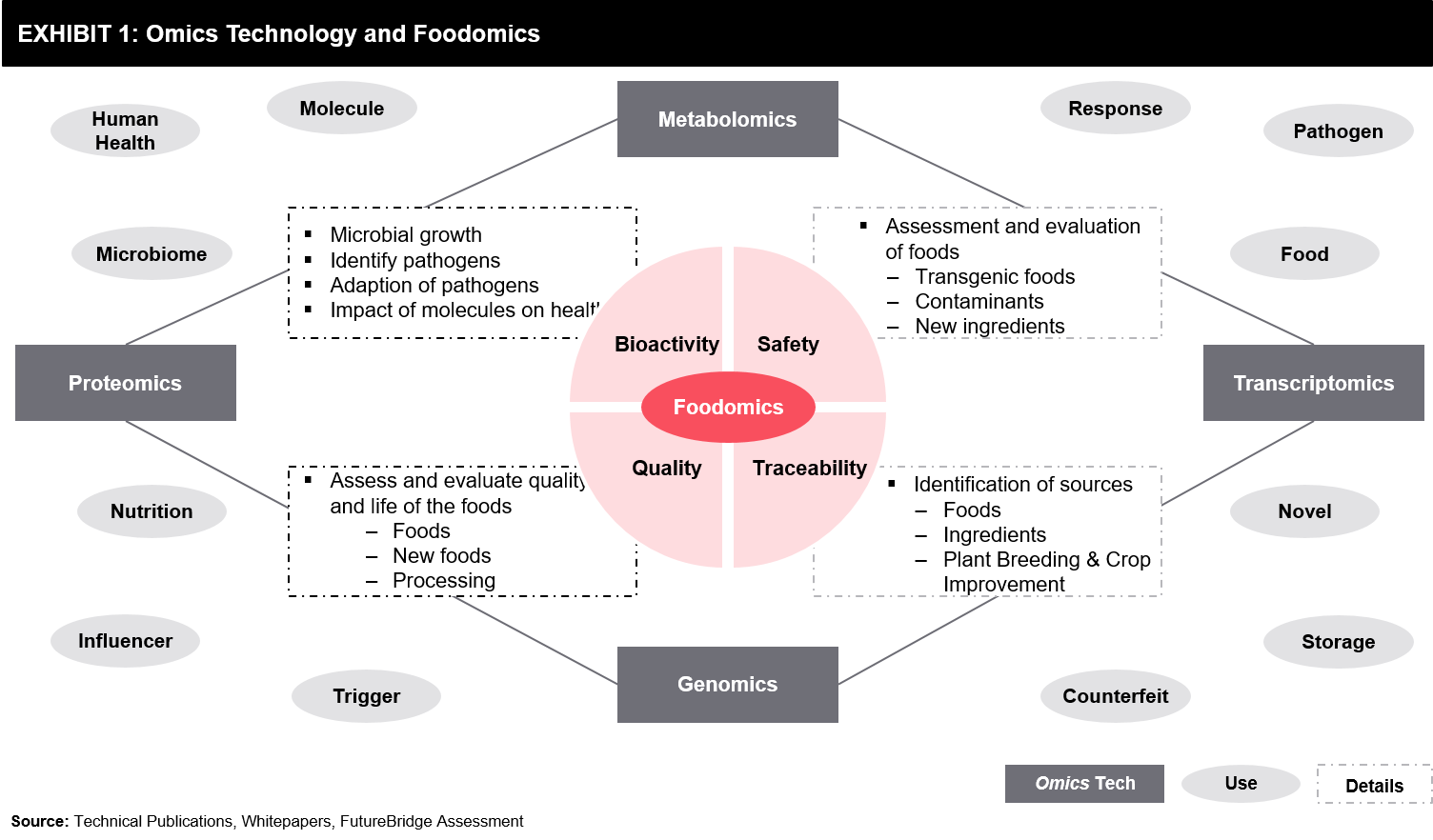
Introduction to Omics Since 2000, food science advancements have led to the integration of food chemistry, food microbiology, and high-throughput omics technologies resulting in “Foodomics,” a universal approach to improve nutrition and analytics. Omics comprises of four technologies – genomics, transcriptomics, proteomics, and metabolomics. A wide range of omics subdisciplines includes epigenomics, lipidomics, and interactomics. Omics approach offers a new tool for researchers to enhance the shelf-life of the produce. Simultaneously, data and analytics provide a foundation for establishing holistic freshness management across the food value chain from farm to the customer’s basket. Advanced analytics and techniques help the food value chain stakeholders to connect, interpret, and automate high-value data and eventually improve fresh product shelf-life. Exhibit 1 illustrates four technologies of omics and its application in the food category.
Enlisted below are the details regarding the omics technologies and their application in food nutrition:
- Genomics: Assessment of diverse responses to foods (personalized diet and health) and its application in accelerating urban farming and crop improvement
- Transcriptomics: Identifying evidence to modulate global gene expression profile by different nutrients, correlating it to disease prevention, and design microbial mitigation strategies for ready-to-eat food products
- Proteomics: Detecting contaminants, allergens, pathogens, cancer-causing food bioactive
- Metabolomics: Identifying unique chemical fingerprints of specific cellular processes for fermentation and similar processes
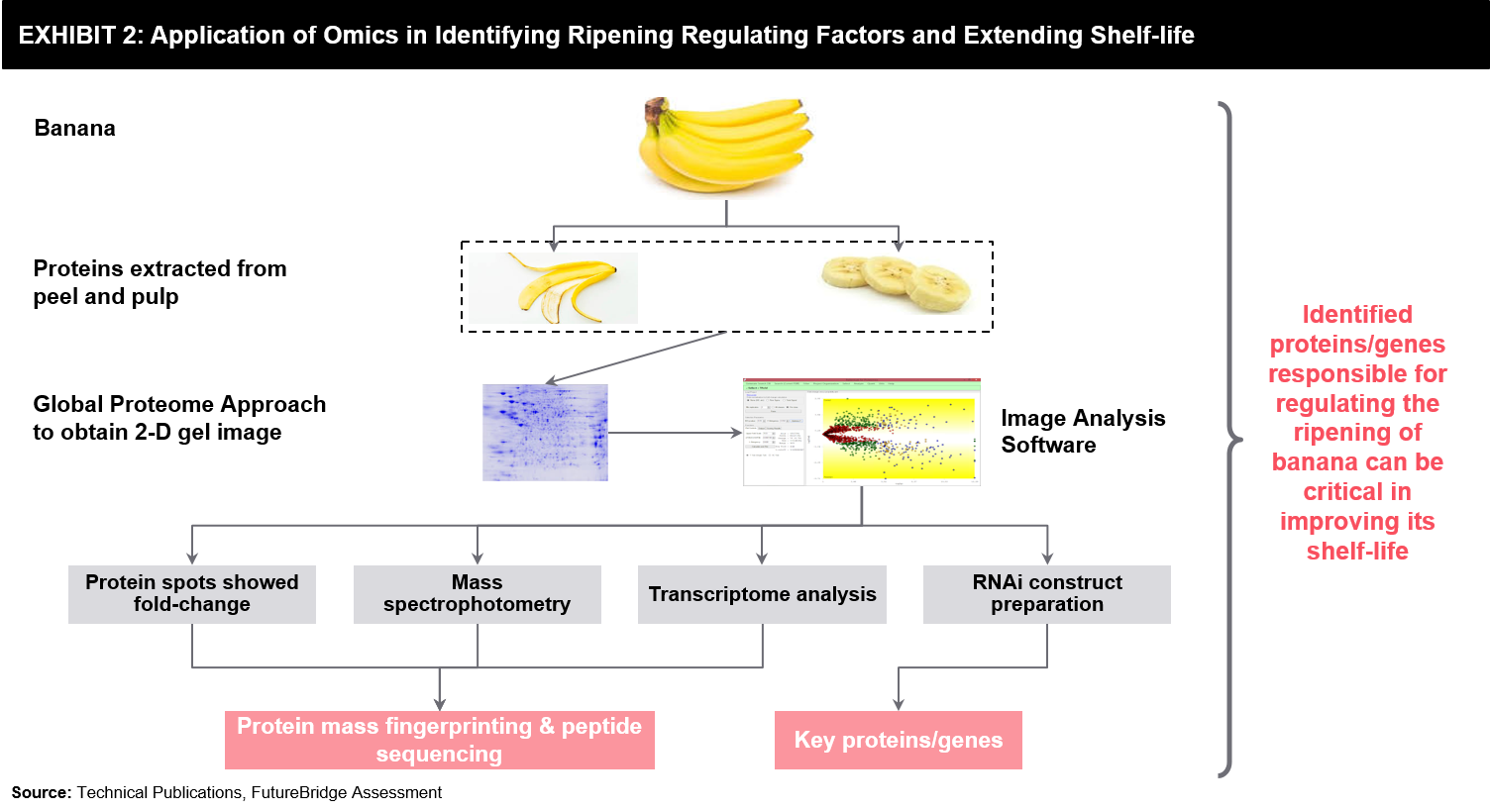
The studies conducted by research institutes show that protein spots increase during maturation and are identified through protein mass fingerprinting using MALDI-TOF/TOF-MS and mass spectrophotometry. The identified proteins/genes responsible for regulating the ripening of banana can be critical in improving its shelf-life.
Omics technology to explore the factors responsible for regulation shelf-life of vegetables
Experts predict that vegetables’ market value is greatly affected by their visual appearance and post-harvest shelf life. Recent progress in omics application on brassicaceous vegetables shows a transgenic approach to prolong broccoli’s shelf-life and improve its marketability. Records show various research studies that use 2-DE gel electrophoresis to identify the responsible genes and compare the proteins of wild type and transgenic lines to express delayed senescence.
Omics assistance to enhance food security
Omics provide insight into microorganisms’ fundamental biological characteristics such as niche adaptation, virulence, and resistance to antimicrobials and environmental stressors (e.g., acid, heat, and desiccation). Identifying the common pathogens and their impact can help food value chain stakeholders manage their shelf-life better.
For example, recently, Salmonella has seen to withstand the dry conditions and low water activity food matrices, which is a concern as Salmonella can result in potential foodborne illness outbreaks. Omics can help interpret the genes responsible for facilitating Salmonella serotypes to survive and persist in the niche. Further exploration regarding the factors promoting microbial growth can help identify potential solutions to inhibit or prevent Salmonella growth.
Is omics a key to improving fresh food sales?
Omics can help identify likely threats to quality & safety, thereby reducing wastage and regulating shelf-life to drive fresh food sales Freshness, a crucial influencer, determines the saleability and marketability of fresh products. Increased demand for fresh fruit, vegetable, and seafood is evident worldwide, with the rise in imports and exports among countries. The increasing trade for fresh foods imposes additional costs of logistics and distribution of fresh foods. Additionally, organizations also have to account for an actual cost of loss of freshness that impacts customer satisfaction, loss of sales, and food waste due to limited supply chain resources (labor, logistics, and handling) and requires additional disposal services. Stakeholders in the food industry often blame the food value chain’s complexity with several factors influencing product quality and saleability. A few factors responsible for influencing the product quality include natural product variation, growing conditions, and cutting/sorting processes. Under controlled conditions, the above-enlisted factors can manage the products’ freshness. Still, unforeseeable factors or variations in the conditions can drastically shorten product shelf-life. Omics can help organizations to determine and identify a few of the unforeseeable conditions such as:- Identify microorganisms limiting product shelf-life
- Facilitate pathogen detection
- Foodborne illness cluster/outbreak detection
- Microbial source tracking investigation
- Omics with data analytics, help detect food authenticity, food integrity, and food fraud
- Value properties of products
- Food-related toxins and allergens
- Effect of food on human health, for example, metabolism by evaluating cell-response
- Factors altering metabolic properties of food components
However, it is a long way to the market adoption of omics for food quality and safety analytics
Current challenges in the application of omics Various concerns regarding the application of omics for food safety, regulatory, and risk assessment purposes need attention, which include:- Knowledge regarding affected genes functioning and biological interpretation of the pathway needs to be considered and used with caution. This knowledge needs to be validated using biochemical or cytological experiments
- In many cases, omics can help detect effects but at a risk of being too sensitive, which can also result in false-positive results, e.g., mRNA expression of dead cells
- There are very few omics studies designed for food safety risk assessment. So statistically significant correlations between omics and the phenotype of food products have not yet been established
- Who is currently using omics in the food industry?
- How is omics integrated with data analytics to provide additional value for risk assessment? Who are the potential technology developers?
- How to explore omics to prevent pathogen growth in a given food matrix? Which type of omics information can help achieve the desired results?
- What databases and applications can help omics data integration? Who are the potential partners?
References
- Recent progress in the use of omics technologies in brassicaceous vegetables
- EFSA – External Scientific Report: Review on the state of art of omics technologies in risk assessment related to food and feed safety
- Advancing food quality and food safety through omics tools
- ‘OMICS’-approach to regulate ripening and enhance fruit shelf-life in banana: an important fruit crop for food security
- Recent progress in the use of ‘omics technologies in brassicaceous vegetables
- Foodomics: a new comprehensive approach to food and nutrition
- Towards a Universal Approach Based on Omics Technologies for the Quality Control of Food
- A flavor of omics approaches for the detection of food fraud