


Article
Behind-the-Meter Energy Storage for Grid Balancing Services
Energy
Growth of Behind-the-Meter Energy Storage Market
The penetration of energy storage in the power sector is continuously increasing. Grid-scale energy storage projects are being deployed globally to balance the grid and support renewable energy integration. While announcements of large energy storage projects capture market attention, there is remarkable growth taking place in the Behind-the-Meter energy storage market. Power supply reliability has been the key driver of the Behind-the-Meter energy storage market. Increasing disruption risk due to severe weather conditions and bottlenecks created due to strained electric grids have led commercial, industrial and residential customers to go for a backup power supply. Falling costs of battery systems, solar-plus-storage benefits, time-of-use utility rate structures, purchase incentives, and payments received for grid services are other drivers. Further, some policy majors like Self-Generation Incentive Program and “clean peak” policies promote the use of Behind-the-Meter energy storage.Behind-the-Meter Batteries for Grid Balancing Services
Utilities across the globe are putting efforts to increase grid reliability and resilience. Many grid modernization and demand response programs are in place for the same. Some utilities are investing in utility-scale energy-storage solutions to improve reliability. Increasing adoption of Behind-the-Meter energy storage systems makes a case for providing grid balancing services. These batteries could be aggregated to dispatch for grid support services. A network of Behind-the-Meter batteries, which consumers have already invested in but are not using every day, can act as a resource on behalf of utilities. As these batteries are already in place, the marginal cost of dispatching these batteries will be considerably low. This could help utilities avoid investing in more costly alternatives like building extra grid infrastructure or using less efficient peaking plants. Behind-the-Meter batteries can be dispatched for frequency regulation, and demand matching as those respond almost instantly to signals to charge or discharge energy. The most common business model adopted to manage the integration of Behind-the-Meter batteries for grid services is the Aggregator (Network Operator) Model. A private company plays the role of an aggregator who aggregates all Behind-the-Meter batteries to form a virtual source of power that is capable of participating in wholesale markets. The aggregator is responsible for deploying and maintaining wholesale-grade meters and communication software. It is also responsible for monitoring and controlling all the connected batteries on behalf of consumers. This includes ensuring that participating consumers receive signals, operations are modified as needed, and they communicate their operational pattern to the aggregator. Some utilities have rolled out programs to facilitate the participation of residential batteries to provide grid services. These utilities pay incentives to the participating consumers for letting use their batteries for grid balancing. Thus consumers can get maximum benefits from the investment in home batteries.Recent Developments
The United States, a leader in the energy storage market, is witnessing multiple pilot programs run by utilities to promote the participation of residential batteries for grid balancing services. Few such programs are detailed below.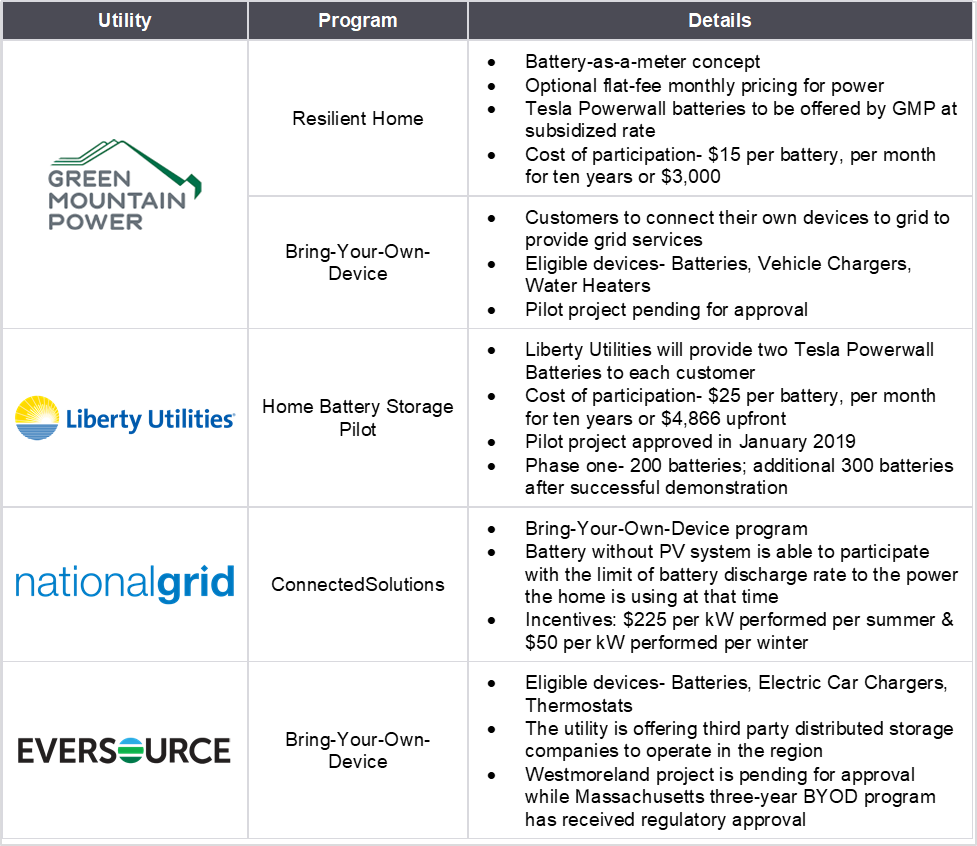 Multiple recent developments depict the interest of private sector players to grab the opportunity in the Behind-the-Meter energy storage aggregation market. Some of these key developments are captured in the following table: