


Addressing the Food Waste Challenge
Food Wastage and its consequences
Food waste is a global issue that needs to be addressed urgently. Its substantial repercussions include both in terms of food security as well as environmental.
Food wastage accounts for 8% of the global greenhouse gas emissions, according to the Food and Agriculture Organization and the World Resources Institute. In contrary to this, 870 million people in the world are undernourished due to food unavailability/ affordability. One-third of produced food for human consumption is lost or wasted globally, amounting to around 1.3 billion tonnes per year.
Environmental Repercussions
Reducing food waste also impacts climate change as 20 percent of US total methane emissions are from landfills. From an environmental viewpoint, food which is wasted after harvest uses a quarter of the water used for agriculture in a year. This becomes a major contributor to global greenhouse gas emissions.
As predicted by The United Nations, we will require 70% more food in order to feed the population projected. There will be more number of youths in the world as well as there will be a low poverty level, which will account for higher daily food intake.
Fruits & vegetables prepared foods, Liquid foods top the category list from waste is generated as depicted in Exhibit1.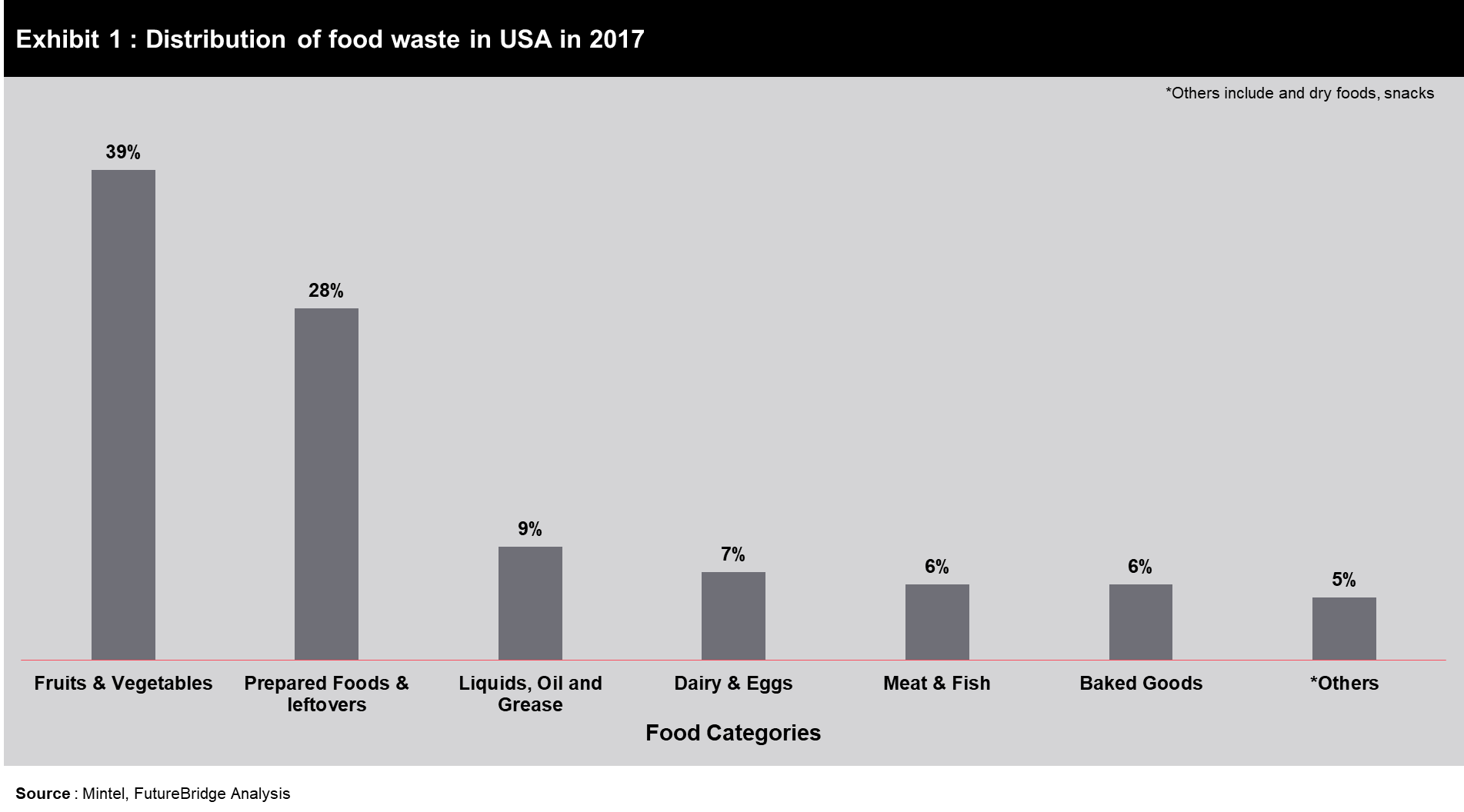
- Agricultural Production: Food losses in farmland is more likely to occur than the other steps. Majority of the losses are due to mechanical damage, spillage during threshing of fruit picking, sorting out due to fruit selection parameters
- Post-harvest handling and storage: losses are majorly due to spillage and degradation during handling, storage, and transportation between the land and the distribution
- Processing: Processing losses differ according to the type of processing. Few of them are common for all kinds of processing plants like raw material spillage in the plant, degradation of long-stored raw materials, and process interruptions. Losses also occur when fruits are unsuitable during washing, sorting, slicing. Some specific industries like beverage based, Bread making have specific food wastage sources
- Juice productions have post-processing food wastes like peels, pulp. Real Good Stuff Co.uses the leftover pulp to make dog treats
- Alcohol industries have sugar extracted grains which are wasted. Regrained has turned the upcycled grains from alcohol industries into super gain flour. This flour is low in sugar, high in fiber content and protein
- Distribution: Includes losses from market system, e.g. at wholesale markets, supermarkets, retailers and wet markets.
- Consumption: Finally, losses also takes place in household systems.
Unique players
 ReFed has provided a unique roadmap for reducing food waste. It has produced a 27 point list of ways to address food waste issue starting from standard date labeling to cold chain management to packaging, to donation to value-added processing solution. The roadmap also includes estimated costs, economic benefits as well as the value of each of the 27 proposed solutions. ReFed roughly estimated that when these solutions will be implemented, they will generate $10 billion and save around 1.8 billion meals, 1.6 trillion gallons of water annually, provide $5.6 billion annual consumer savings and reduce greenhouse gas emissions by 18 million tons annually along with $1.9 billion annual business profits.
 Winnow technologies are using Artificial Intelligence for helping food companies/ restaurants/ cafes to reduce food wastage. They have automated food waste capture to provide more precious insight to help kitchen teams reduce waste, thereby increasing efficiency. With the help of their technology, players like IKEA, Marriott International, Accor hotels, Costa Cruises have aimed at reducing food losses.
USDA has sourced out a hierarchy for addressing food wastage. Reduction at the source of the wastage tops the pyramid as this would result in better recovery as depicted in Exhibit 2.
Winnow technologies are using Artificial Intelligence for helping food companies/ restaurants/ cafes to reduce food wastage. They have automated food waste capture to provide more precious insight to help kitchen teams reduce waste, thereby increasing efficiency. With the help of their technology, players like IKEA, Marriott International, Accor hotels, Costa Cruises have aimed at reducing food losses.
USDA has sourced out a hierarchy for addressing food wastage. Reduction at the source of the wastage tops the pyramid as this would result in better recovery as depicted in Exhibit 2.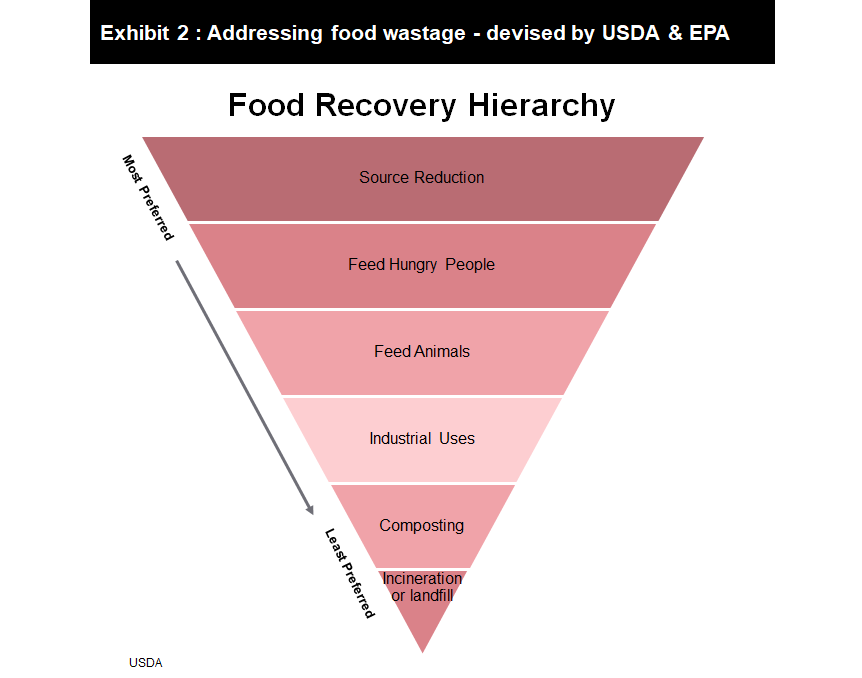
Initiatives taken by players
Company-led initiative
- Food Waste Alliance

 Orora has brought product packaging innovation to Australia’s cold supply chain. They are using Xsense® HiTags in any perishable product package to gather real-time storage information from farm to retail outlet transmitted through online alerts. BT9 is an Israeli company that has developed Xsense, an innovative cold chain monitoring system. Xsense system provides real-time, accessible data, allowing in-prompt decisions for better quality assurance practices. The data is visible to all stakeholders
Food Processing (Food Donations, Policy Reforms)


 TetraPak is applying World Class Manufacturing principles for cutting down waste in their plant. By doing this, they can reduce waste, minimize water loss, improve efficiency, and reduce energy consumption across all our operations. TetraPak claims to recycle close to 100% material waste.
Retails markets (Technological)
 HelloFresh is the largest meal kit company in the USA. It is using Spoiler Alert software in its distribution centres. This software analyzes waste and suggests reduction tactics. In addition, it also integrates food donation into workflow to avoid food into landfill. Spoiler Alert also has the food giant Sysco as its customer.

 Grind2Energy (by Emerson) has partnered with Whole Foods Market to help the company succeed with its commitment and dedication to environmental responsibility. It is installing a food recycling system for converting them into fertilizers. This has drastically reduced their wastes going into landfills from their stores. Since, 2014, Grind2Energy has helped Whole Foods produce 220000 pounds of nutrient-rich fertilizes, eliminate greenhouse emissions (having equivalency of 2.5 million automobile miles), and convert enough natural gas to heat about 850 homes for one month.
Restaurants/ Café (Technological)

 Winnow technologies has automated food waste capture to provide richer insight to help kitchen teams reduce waste, thereby increasing efficiency. It’s a smart technology that weighs the food being trashed in the trash can. And, then the kitchen staff have to input the food they are throwing away. As they input the data, it showed insights on how much they are losing cash over a year and its environmental impact. Winnow has helped Ikea to save 350,000 meals worth about $900,000 in 8 months. Winnow vision is installed in 23 stores of the UK & Ireland. And, help them cut down food waste by 50%. Hence saving 1.2 million meals.
Government-led initiatives
A significant number of countries have started taking initiatives in order to reduce/ manage their food wastage. Some of them includes:
- Dubai
- France
- Italy
- Denmark
- South Korea
- Australia
References
- FAO website
- USDA Website
- EPA website
- Winnow technologies
- Statistica
- IFCO