

In-Depth Read
E-Fluids – Future of Automotive Lubricants
Mobility
E-Fluids Explained
By now, there is no doubt that e-mobility is here to stay. Questions concerning the speed, dependability, distance range of EVs have been addressed to the satisfaction of a growing number of consumers – to the point where demand is steadily shifting in favor of them over ICE vehicles. Along with consumer demand, of course, is the fact that automakers must meet ever-stricter carbon dioxide emission targets and fuel economy mandates imposed by governments. The production of EVs is expected to reach 50% of all vehicles made by 2030. Predictions from the World Economic Forum (WEF) show that the global car market could double-up by 2045. Mainly boosted by strong EV sales push initiatives such as subsidies from Governments of up to 20-25% of the vehicle’s cost in Europe, focus on reducing greenhouse gas emissions by around 80% by 2050, and developing improved charging infrastructure by the Japanese government. China alone plans to sell almost 2 million EVs by 2021, close to 2018 global EV sales. As one out of every two cars sold globally is expected to be electrified by 2030, it’s not surprising that the lubricants industry is moving to capitalize on this opportunity by diversifying into e-fluids. E-fluids, as the name suggests, are fluids developed specifically for the EVs and are promoted with the value proposition of enhancing EV performance, range, and durability. Though there can be various automotive fluids for E-mobility, these are broadly classified into three categories. E-transmission fluids that are used in battery electric vehicles (BEVs), plug-in hybrids (PHEVs), and fuel cell electric vehicles (FCEVs). Second are the E-greases designed to counter noise, vibration, and harness (NVH) levels within the electric vehicles. Third are the E-thermal fluids, which are themselves further sub-categorized into three types of thermal management solutions. Exhibit 1 presented below shows three major categories of E-fluids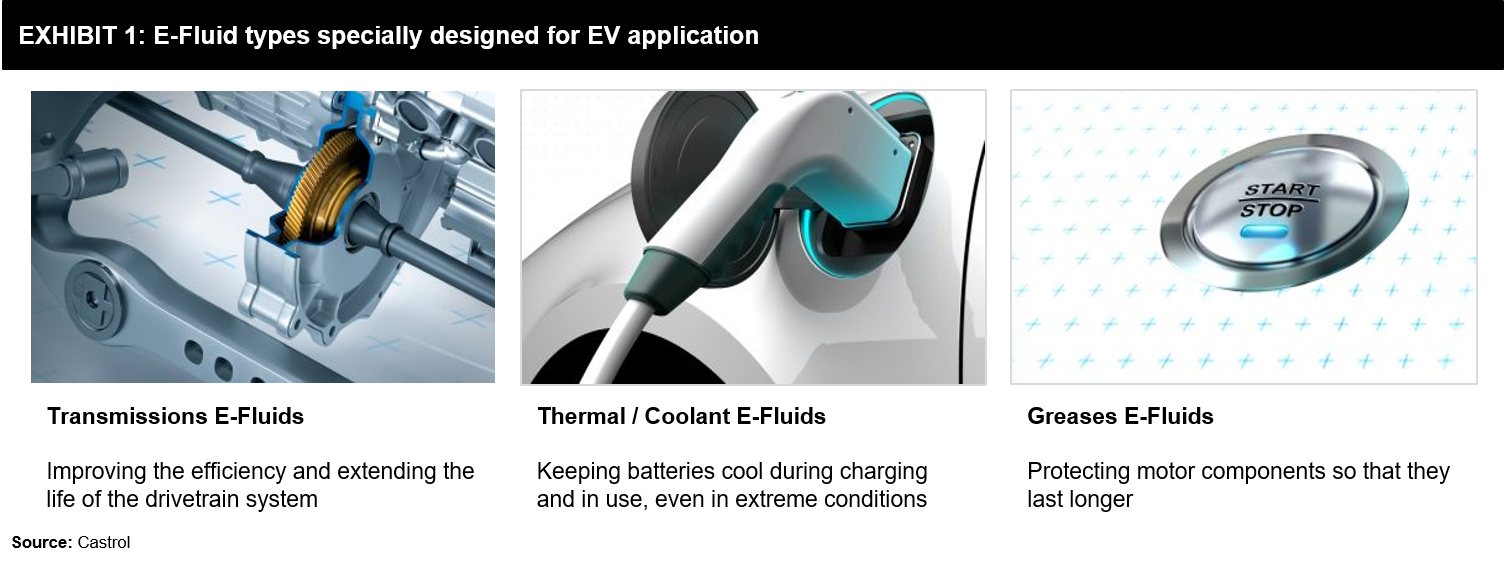 In addition to the broader classification of E-fluids, further, there are three sub-type of e-thermal fluids today:
- The first of these is air cooling found in the Toyota Prius, Nissan Leaf, and Kia Soul, in which there is no e-thermal fluid present.
- The second is liquid cooling, where a type of e-thermal fluid is present. These are predominantly glycol-water-based solutions used in the Audi eTron, BMW i3, and Tesla Model S.
- The third category is immersion-based (dielectric fluids), PCMs (phase-change materials), or oil-based solutions. Although they are the most effective of the three, they are still likely to experience minimal adoption in the next decade due to higher costs.
Why is there a growing need for E-fluid solutions?
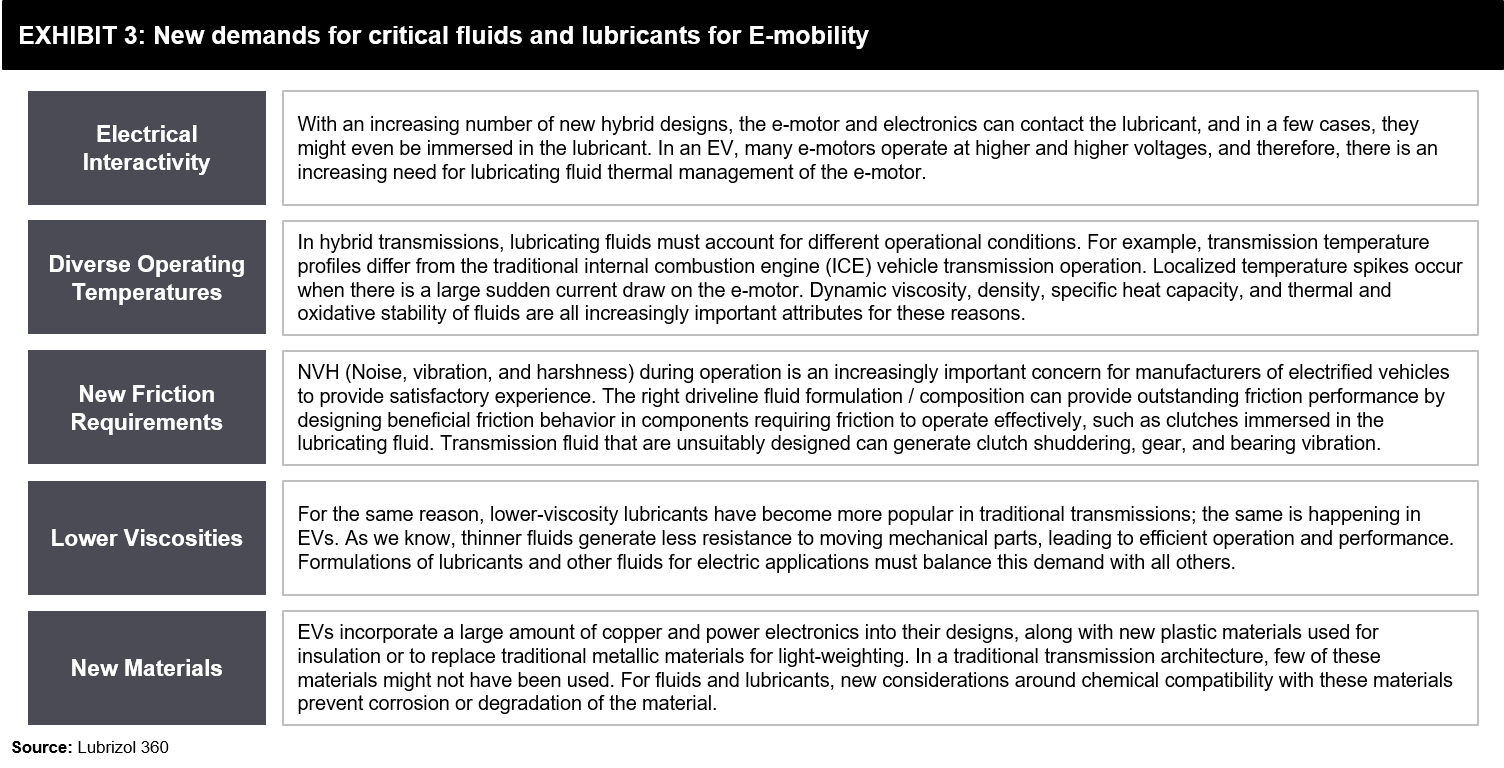
Growth in Electric Vehicle sales and usage is the key driver of Research and Development in E-fluid solutions. Today, most of the OEMs are developing active thermal management systems with e-thermal or cooling fluids for next-generation EVs. For example, future BEV models from Audi will have an active liquid thermal management system. Toyota will adopt the active cooling strategy for its high capacity hybrid segment post-2022. Nissan Leaf, the highest-selling EV model in Europe, will feature an active liquid cooling system post-2020. Therefore, its no surprise that lubricant companies are already looking to collaborate with OEMs to develop e-thermal or cooling fluids for high-performance EVs. A prime example is a partnership between Taiwan-based XING Mobility and 3M Novec Engineered Fluids to develop an immersion cooling system for EV batteries. Similarly, Shell has created customized fluids like the Shell Helix Hybrid for hybrids. Until recently, E-fluids was still pretty much a niche market for automotive participants. As of date, the limited uptake of ‘First Fill’ e-fluids meant that the subsequent demand for ‘Service Fill’ was virtually non-existent. However, as per the recent trends and related research, this is all set to change soon. Recent research has estimated that by 2025, nearly 40 million liters of e-thermal fluids, e-transmission fluids, and e-greases will be sold across eight major markets with the highest EV penetration levels — Germany, France, the U.K, Norway, Netherlands, China, U.S, and Japan. According to numerous estimates, lubricant consumption for ICE vehicles is expected to reduce by 2030 compared to the demand for lubricants and other fluids specially designed for Electric vehicles. Below, Exhibit 2 provides a perspective of the overall market for Lubricant consumption for ICE vehicles, hybrid/plug-in hybrid, and battery-electric vehicles.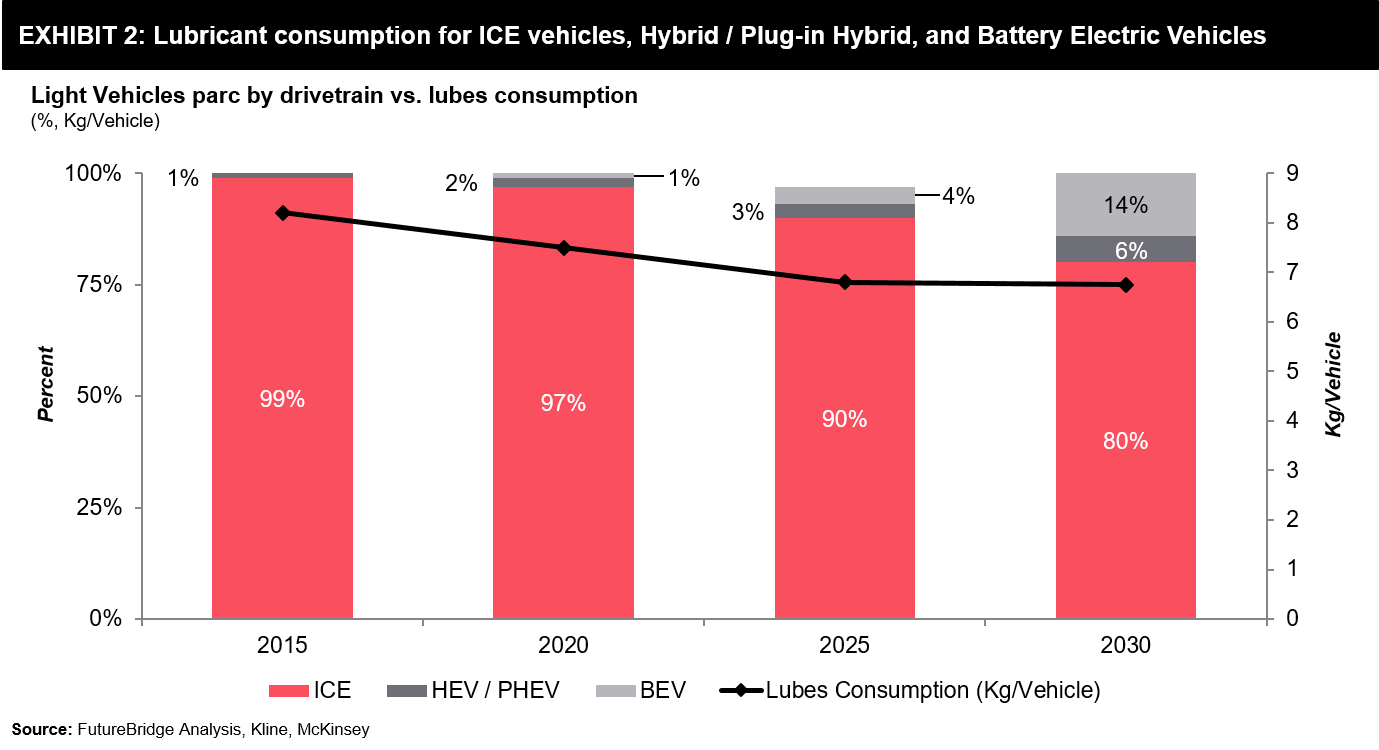 Hybrid electric vehicle technology is evolving rapidly, and it’s vitally important that the fluid and lubricant additive technology keeps up with this rapid evolution. Whether it’s in a plug-in hybrid, full-hybrid, or all-electric vehicles, new hardware configurations have increased demands for critical fluids and lubricants — and some of these requirements and related solutions are entirely new. New lubricants and fluid technology need to focus on delivering the following benefits:
- Suitable thermal management
- Compatibility with new plastics
- Superior corrosion protection
- Proper electrical characteristics
- Smooth friction performance for NVH benefits