

Composite Biomaterials: Fiber-Reinforced Implants, HA Hybrids & Dental Composites
Biomaterials in medical devices / Metallic biomaterials in orthopedics
Metallic biomaterials & orthopedic device strategy
Metallic biomaterials in orthopedics: the challenge is no longer whether to use metals, but which metal to use, where, and at what regulatory, IP and biological cost.
Orthopedic implants still rely on metals because no other material class can match their performance in demanding load-bearing applications. Hip, knee, and spinal systems must survive tens of millions of loading cycles without catastrophic failure, while maintaining fixation and biological compatibility.
The strategic question has shifted from material discovery to execution: balancing wear, corrosion, osseointegration, stress shielding, ion release, manufacturability and commercialization readiness. Metal choice now sits at the intersection of engineering, regulatory strategy, IP, and portfolio economics.
In metallic biomaterials, platform novelty matters less than how well teams manage mechanical risk, biological response, regulatory durability, and long-term value creation.
Building on FutureBridge perspectives on biomaterials in medical devices, polymeric scaffolds and PEEK alternatives, and biomaterial commercial viability, this page positions metallic biomaterials as a core strategic layer in orthopedic device design when fatigue, wear, osseointegration and regulatory precedent all need to be engineered together.
Figures indicative; align with internal regulatory and market assumptions before publication.
Why metals remain critical in load‑bearing implants
Advanced orthopedic devices increasingly require more than bulk material performance. They need controlled mechanical behaviour, predictable wear, stable corrosion profiles, and interfaces that support bone in‑growth and long‑term fixation. Metallic biomaterials remain central because they handle sustained, dynamic loads where failure is catastrophic, not gradual.
Alternative classes such as polymers, composites, and ceramics offer important advantages — reduced stiffness, tailored degradation, or bioactivity — but they rarely replace metals outright in major load‑bearing roles. For the broader context of how metals sit alongside other biomaterial platforms, see What are biomaterials?.
Design signal
- Metal selection defines fatigue life, wear behaviour, corrosion resistance and ion‑release risk.
- Surface engineering, porosity, and architecture drive osseointegration and stress distribution.
- Regulatory evidence, IP exposure, and manufacturing reproducibility all hinge on early material and process choices.
Clinical reality
Catastrophic failure avoidance
Hip, knee and spine implants must survive tens of millions of cycles without sudden fracture. Titanium and CoCr alloys remain the only widely accepted material systems with proven fatigue and fracture performance at this scale.
Biomechanics
Strength vs. bone response
Stiff metals protect against structural failure but can divert load away from bone, creating stress shielding and long‑term instability. Porous architectures and lower‑modulus metals such as magnesium aim to resolve this tension.
Risk profile
Ion release & wear
Cobalt, chromium, nickel and titanium ions reshape regulatory scrutiny and clinical expectations. Experience with metal‑on‑metal hips has made ion characterization and wear testing design‑stage requirements rather than late‑stage checks.
Commercialisation
Evidence, IP, and scale‑up
Winning programmes link metal choice to manufacturing reproducibility, IP defensibility, pricing logic, and lifecycle economics rather than treating it as a narrow materials decision.
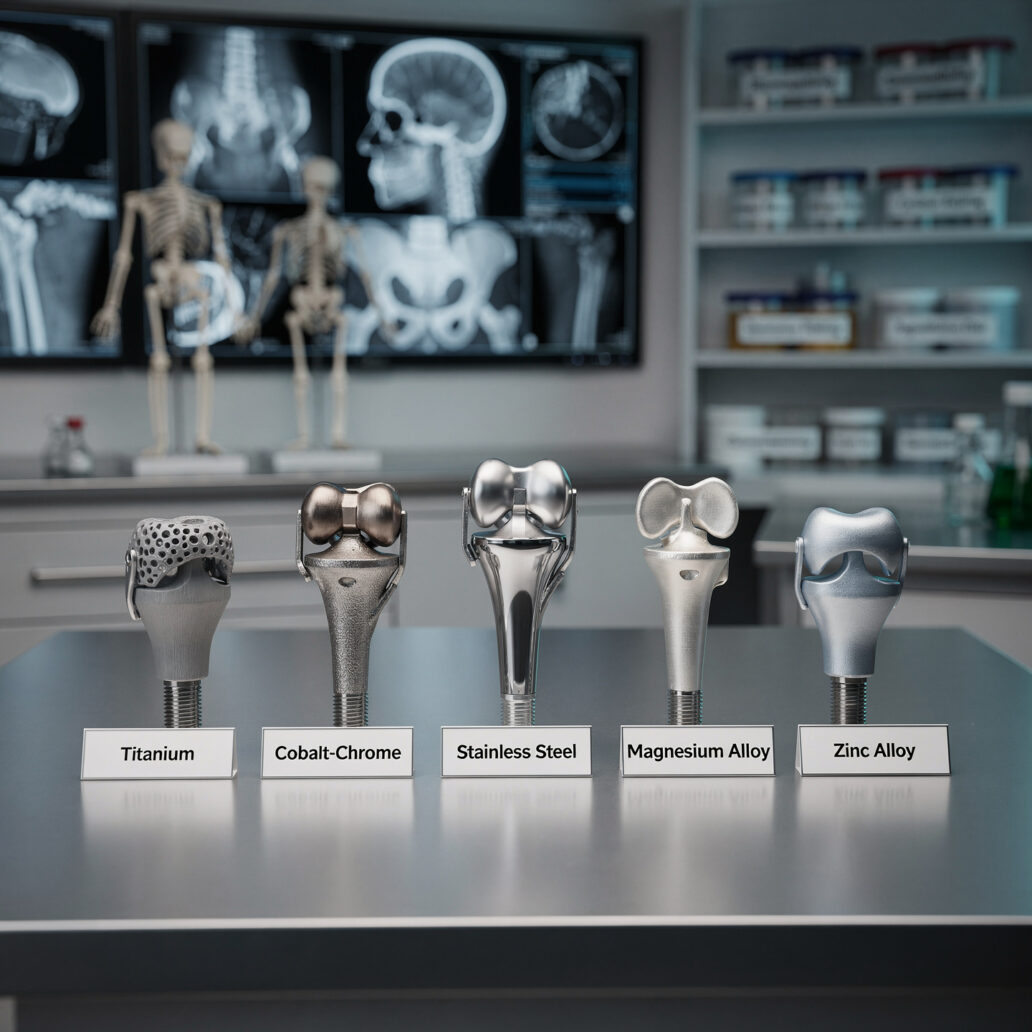
The 4 core metallic biomaterial classes in orthopedics
Titanium, cobalt‑chromium, stainless steel and biodegradable magnesium/zinc alloys occupy distinct roles in orthopedic design. Each represents a different balance between strength, wear, corrosion, modulus, biological behaviour and commercialization complexity.
Titanium and Ti‑6Al‑4V
The gold standard for permanent load‑bearing implants. Titanium combines excellent corrosion resistance, strong osseointegration and one of the best strength‑to‑weight profiles among widely used implant metals.
Primary applications: Cementless hip and knee systems, spinal fusion cages, pedicle screws, dental implants and trauma fixation.
Innovation signal: Commercially pure titanium, titanium‑zirconium alloys and porous printed titanium are being used to tune stiffness, in‑growth behaviour and ion‑release performance, often in combination with hydroxyapatite and bioactive ceramic coatings.
Cobalt‑Chromium alloys
Unmatched wear resistance. CoCr alloys deliver hardness and wear performance that titanium cannot match, making them central in articulating and thin‑section high‑stress components.
Primary applications: Femoral heads, acetabular components, tibial bearing surfaces, spinal disc replacements, valve frames and dental frameworks.
Innovation signal: Clinical setbacks related to ion release have narrowed acceptable design space; pre‑market ion profiling and wear testing are now core design requirements rather than optional extras.
Stainless steel (316L / 316LVM)
The cost‑effective solution for temporary fixation. Stainless steel offers clinical familiarity, lower manufacturing cost and a mature supply base, making it attractive where implants are expected to be removed.
Primary applications: Bone plates, trauma screws, rods, nails, external fixation systems and surgical tools.
Innovation signal: Nickel sensitivity, crevice corrosion and longer‑term evidence expectations limit the ability of stainless steel to move into premium permanent implant roles.
Biodegradable Mg / Zn alloys
The most strategic and hardest‑to‑commercialize metallic class. Magnesium’s modulus is closer to cortical bone, reducing stress shielding, while zinc offers slower degradation and longer fixation windows.
Primary applications: Temporary fixation screws, pins, pediatric implants, small bone fracture devices and selected cardiovascular concepts.
Innovation signal: Hydrogen evolution, degradation control, coatings, processing compatibility and freedom‑to‑operate are now central. This connects directly to FutureBridge perspective on biomaterial commercial viability.
A practical framework for selecting the right metal
No metal performs best on every criterion. The right choice depends on how the implant balances strength, modulus, corrosion behaviour, osseointegration, clinical precedent, IP position and lifecycle economics. The table below provides a screening view for R&D and portfolio teams.
| Criterion | Titanium / Ti‑6Al‑4V | CoCr | 316L Stainless steel | Mg / Zn biodegradable |
|---|---|---|---|---|
| Mechanical strength | High | Very high | High | Moderate |
| Corrosion resistance | Excellent | Good | Moderate | Intentionally degrades |
| Osseointegration | Excellent | Good | Moderate | Potentially favourable |
| Stress shielding risk | Moderate | High | High | Low |
| Ion release concern | Low to moderate | High | Moderate | Physiological ions; degradation control critical |
| Regulatory readiness | Excellent | Good with narrower use cases | Strong in temporary fixation | Emerging / novel |
Key pain areas in metallic biomaterial programmes
The main failures in metallic biomaterials do not come from basic material science. They arise from predictable execution gaps in wear, corrosion, fixation biology, stiffness mismatch and strategy timing.
1. Underestimating ion‑release risk in metal‑on‑metal environments
Adverse tissue reactions in metal‑on‑metal hips showed how quickly assumptions about corrosion and wear can fail in high‑load articulation. Ion‑release profiles now drive design constraints and evidence expectations for CoCr‑heavy platforms.
2. Stress shielding driving long‑term instability
When a stiff metallic implant carries too much load compared with surrounding bone, bone resorbs over time, eroding the mechanical foundation for fixation. Porous titanium lattices and lower‑modulus biodegradable metals are direct responses to this failure mode, often in combination with polymeric scaffolds and PEEK alternatives.
3. Investing in biodegradable metals without securing platform IP and scale‑up logic
Magnesium and zinc concepts respond to real clinical pain points, but alloy, coating and degradation‑control claims are becoming crowded. Without a platform view on IP, manufacturing and evidence, programmes risk becoming technically impressive but commercially constrained.
FutureBridge perspective
Metallic biomaterials are shifting from legacy choice to portfolio strategy
Metal selection used to be treated as a relatively fixed parameter in orthopedic device design. Today it is a strategic lever that shapes performance, evidence burden, IP differentiation and long‑term portfolio economics across hip, knee, spine, trauma and emerging resorbable platforms.
The key decision is not whether metals remain relevant. It is which metal systems fit which indications, how they interact with polymeric, ceramic and composite layers, and how early design choices can preserve regulatory and commercial optionality instead of closing it down.
Frequently asked questions
What metals are used in orthopedic implants?
Titanium and titanium alloys, cobalt‑chromium alloys, stainless steel and emerging biodegradable magnesium and zinc alloys form the core metallic classes in orthopedic device design.
Why is titanium preferred in many orthopedic implants?
Titanium combines strong corrosion resistance, high strength‑to‑weight performance and excellent osseointegration, making it highly effective in permanent load‑bearing hip, knee, spine and dental systems.
What is stress shielding in orthopedic implants?
Stress shielding occurs when an implant is much stiffer than surrounding bone and carries a disproportionate share of mechanical load. Bone responds by resorbing, which can lead to periprosthetic bone loss and implant loosening over time.
What are biodegradable metal implants?
Biodegradable metal implants are devices made from alloys such as magnesium or zinc that degrade in a controlled physiological environment, providing temporary fixation without requiring permanent implant retention.
How should MedTech companies think about metallic biomaterial strategy?
The strongest programmes evaluate metals not only on mechanical performance, but also on ion‑release risk, osseointegration needs, stiffness mismatch, manufacturing scalability, reimbursement logic, IP position and long‑term portfolio fit. That perspective is best developed alongside platform views on polymeric scaffolds, composites and regenerative architectures.