

Polymeric Biomaterials & Scaffolds: PLA, PLGA, PEEK and Beyond
Polymeric Biomaterials & Scaffolds
Why polymeric biomaterials are the hardest class to translate from lab to commercial medical devices
Polymers are the most versatile material class in medical devices and the one where the gap between laboratory performance and commercial reality is widest, most expensive, and most often discovered too late.
A PLGA scaffold that degrades precisely on schedule in a 37°C phosphate buffer does not always behave the same way after terminal sterilisation, three years of shelf storage, and implantation into a real patient.
The polymer has not failed. The translation process has.
This article maps the full landscape of polymeric biomaterials and scaffold types, applications, key design parameters, common scale-up failure points, and regulatory requirements, and connects it back to the broader context of biomaterials in medical devices.
The polymer selection decision does not just determine biological performance. It also shapes sterilisation approach, shelf life, regulatory classification, manufacturing process, and IP positioning.
Why polymers dominate the biomaterials landscape
No other material class offers the same combination of tunable properties. Molecular weight, copolymer ratio, crystallinity, porosity, surface chemistry, and crosslink density can all be adjusted to shift mechanical performance, degradation rate, and cell interaction profile.
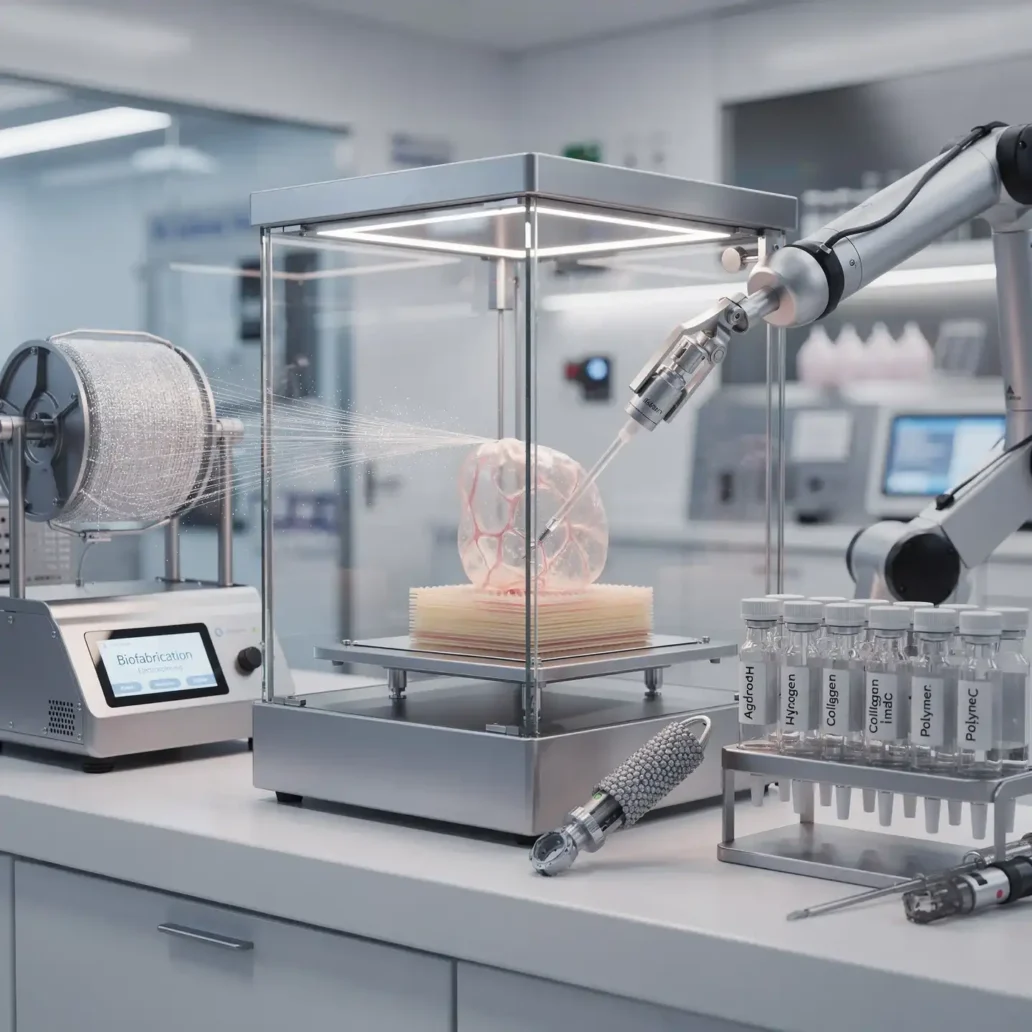
Polymers underpin sutures, drug delivery systems, resorbable implants, long-term soft tissue replacements, scaffold matrices, and now the bioinks used in 3D bioprinting — covered in depth in Biofabrication & Clinical Applications of Biomaterials in Biomedical Engineering.
That versatility is also what makes polymers the hardest class to translate from lab to clinic. Each processing decision, from solvent choice to sterilisation method to storage conditions, shifts the material properties. An R&D team that optimises a polymer scaffold in a controlled lab environment and then hands it to manufacturing without a systematic process characterisation programme is making a very expensive assumption.
Biodegradable vs biostable: the strategic trade-off
This is not a purely chemistry decision. It shapes every downstream function in the product programme.
Biodegradable polymers
Resorb after use, avoiding secondary surgery but requiring extensive evidence on degradation, safety, and consistent performance within a defined clinical window.
Sterilisation compatibility, degradation by-products, and shelf life become primary design constraints.
Biostable polymers
Remain in the body, leveraging long-term stability and more established regulatory pathways, but carry risks of late-stage complications and ongoing surveillance.
Subtle changes in formulation or processing can still alter long-term performance and evidence requirements.
This choice directly impacts sterilisation compatibility, shelf life, regulatory classification, testing scope, and compliance requirements, all of which must be addressed early.
Core polymer types: biodegradable and biostable
The table below covers the clinically active polymer types across both segments, with key properties, primary applications, and a commercially available device reference for each.
| Polymer | Segment | Degradation Profile | Primary Application | Commercial Device Reference |
|---|---|---|---|---|
| PLA (Polylactic acid) | Biodegradable | ~12–24 months (grade-dependent) | Bone screws, fixation devices, scaffolds | Biofix resorbable screw (Biomet) |
| PLGA (Poly lactic-co-glycolic acid) | Biodegradable | ~1 week to 12 months (ratio-dependent) | Drug delivery, sutures, tissue scaffolds | Lupron Depot microspheres (AbbVie) |
| PGA (Polyglycolic acid) | Biodegradable | ~2–4 weeks, fast resorption | Short-term scaffolds, absorbable sutures | Dexon suture (Covidien) |
| PCL (Polycaprolactone) | Biodegradable | ~2–4 years, very slow | Long-term scaffolds, drug-eluting implants | Monocryl blend component (Ethicon) |
| PEEK | Biostable | No degradation, chemically inert | Spinal cages, dental abutments | PEEK-OPTIMA spinal interbody (Invibio) |
| Silicone (PDMS) | Biostable | No degradation, long-term flexible | Breast implants, catheters, joint spacers | Various Class III devices |
| UHMWPE | Biostable | No degradation, high wear resistance | Acetabular cup liners, knee tibial trays | Marathon liner (DePuy Synthes) |
Note: PLGA degradation rate is primarily controlled by the lactic-to-glycolic acid ratio. A 50:50 ratio degrades fastest (weeks to months); an 85:15 ratio can extend beyond one year. Molecular weight and processing-induced crystallinity also shift the in vivo timeline, often in ways that in vitro accelerated testing does not fully capture.
Scaffold architecture: parameters that determine clinical outcome
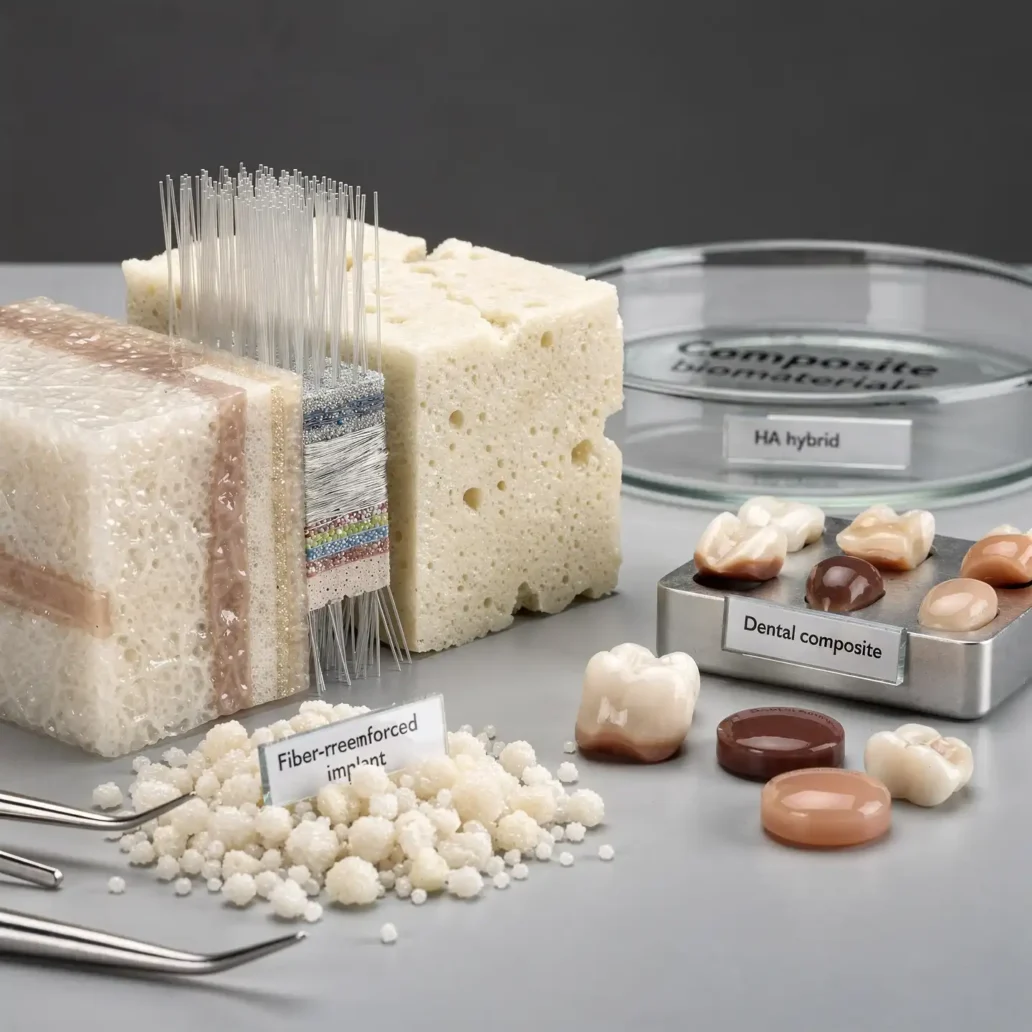
A polymer scaffold is not a passive structural support; it is an engineered biological environment. The four parameters below most directly determine whether a scaffold performs as designed in vivo, and where most design failures originate when they are not controlled systematically. For the ceramics-polymer composite context (including HA–PLGA scaffold design) see Ceramic Biomaterials: Hydroxyapatite, Bioactive Glass and Bioceramic Implants.
-
Porosity and pore architecture
Cell infiltration, nutrient diffusion, and vascularisation depend on pore size and interconnectivity. Bone scaffolds typically require 100–400 µm pores for osteoblast migration, while soft tissue scaffolds follow different ranges. Pore geometry, not just size, determines whether cells distribute uniformly or cluster at the surface.
-
Porosity and pore architecture
-
Degradation rate alignment
The scaffold must maintain mechanical integrity long enough for target tissue to develop load-bearing capacity, then resorb at a rate that does not outpace tissue maturation. A bone fixation device needs weeks to months; cartilage repair may need one to two years.
-
Degradation rate alignment
-
Mechanical property matching
A scaffold stiffer than surrounding tissue creates stress shielding; one that is too compliant fails to transmit load for mechanically stimulated development. The goal is a profile that approximates native tissue and degrades gracefully without abrupt changes in load transfer.
-
Mechanical property matching
-
Surface chemistry and bioactive factor loading
Cell adhesion, proliferation, and differentiation are surface-mediated. Unmodified polymer surfaces can be too hydrophobic; plasma treatment, protein coatings, or RGD motifs address this. For drug-eluting scaffolds, surface chemistry also governs release kinetics of growth factors, antibiotics, or anti-inflammatory agents.
-
Surface chemistry and bioactive factor loading
Major failure modes while scaling up
This is where most polymer scaffold programmes lose the time and budget that were never in the original plan. All three failure modes below are predictable; none are inevitable with early process characterisation.
1. Sterilisation alters the validated material
Gamma irradiation can reduce polymer molecular weight via chain scission, accelerating degradation and compromising mechanical properties. EtO adds residue removal validation; steam is incompatible with most biodegradable polymers.
Credible solution: Define the sterilisation method at material selection and explicitly map compatibility for each polymer before committing to a design.
2. Degradation rate drifts across scales and batches
Processing-induced shifts in molecular weight, crystallinity, and residual solvent can change degradation between 100-unit lab runs and 10,000-unit commercial runs. Bio-based feedstocks add additional batch variability.
Credible solution: Encapsulation strategies using zinc oxide and silicon dioxide fillers can extend device lifetime beyond 40 days and stabilise degradation across scales; build-vs-buy analysis for such technologies is an early-stage decision.
3. Shelf-life exposes formulation weaknesses
A 24-month shelf-life requirement creates stresses that accelerated in vitro studies miss: hydrolytic degradation in storage, moisture ingress, and physical changes under compression in transit.
Credible solution: Run shelf-life studies in parallel with design validation, not sequentially, and identify the shelf-life limiting factor early enough to redesign around it.
How polymer choice shapes the regulatory pathway
The regulatory pathway for a polymeric biomaterial device is not determined by intended use alone. Polymer class, origin, processing history, and degradation behaviour all influence classification and evidence requirements.
| Polymer Category | ISO Standard | FDA Pathway | EU MDR Consideration | Key Watch Point |
|---|---|---|---|---|
| PLA / PLGA / PGA (established grades) | ISO 10993 series + ISO 10993-13 (degradation) | 510(k) with predicate for established formulations | Clinical equivalence possible for well-precedented formulations | Novel copolymer ratios or molecular weights may lose predicate status. |
| Novel biodegradable polymers | Full ISO 10993 biocompatibility workup required | De Novo or PMA; no 510(k) predicate | Full clinical investigation likely required under Art. 61 | Degradation by-product characterisation is mandatory, not optional. |
| PEEK and biostable engineering polymers | ISO 10993 + ASTM F2026 (PEEK) | 510(k) well-supported for established PEEK grades | CE marking via established notified body pathway | Surface modification or drug loading can change the classification basis. |
| Silicone | ISO 10993 + ISO 14607 (breast implants) | Class III PMA for most implantable silicone | Special notified body scrutiny post-PIP | Post-market surveillance requirements are significant. |
| Bio-based polymers (novel feedstocks) | Full ISO 10993 + feedstock traceability | Treated as novel regardless of polymer class | Novel material pathway; PFAS-free claims must be substantiated | EU REACH PFAS restrictions may affect processing aids in the supply chain. |
Next-gen polymer platforms
Three polymer-based platforms are at the most advanced stage of commercial translation and warrant active roadmap attention from R&D teams building five- to ten-year pipelines.
Smart hydrogels
Crosslinked networks that respond to pH, temperature, or enzymatic signals to trigger controlled drug release or change mechanical properties in situ. Wound care and local drug delivery are nearest-term; injectable in situ gelling systems are in cartilage and disc repair trials.
Shape-memory polymers
Pre-deformed constructs that recover their programmed shape when triggered by body temperature or other stimuli. Primary targets include minimally invasive delivery, self-expanding stents, and wound closure devices, with active IP filing in vascular and urological indications.
Bioprinted polymer scaffolds
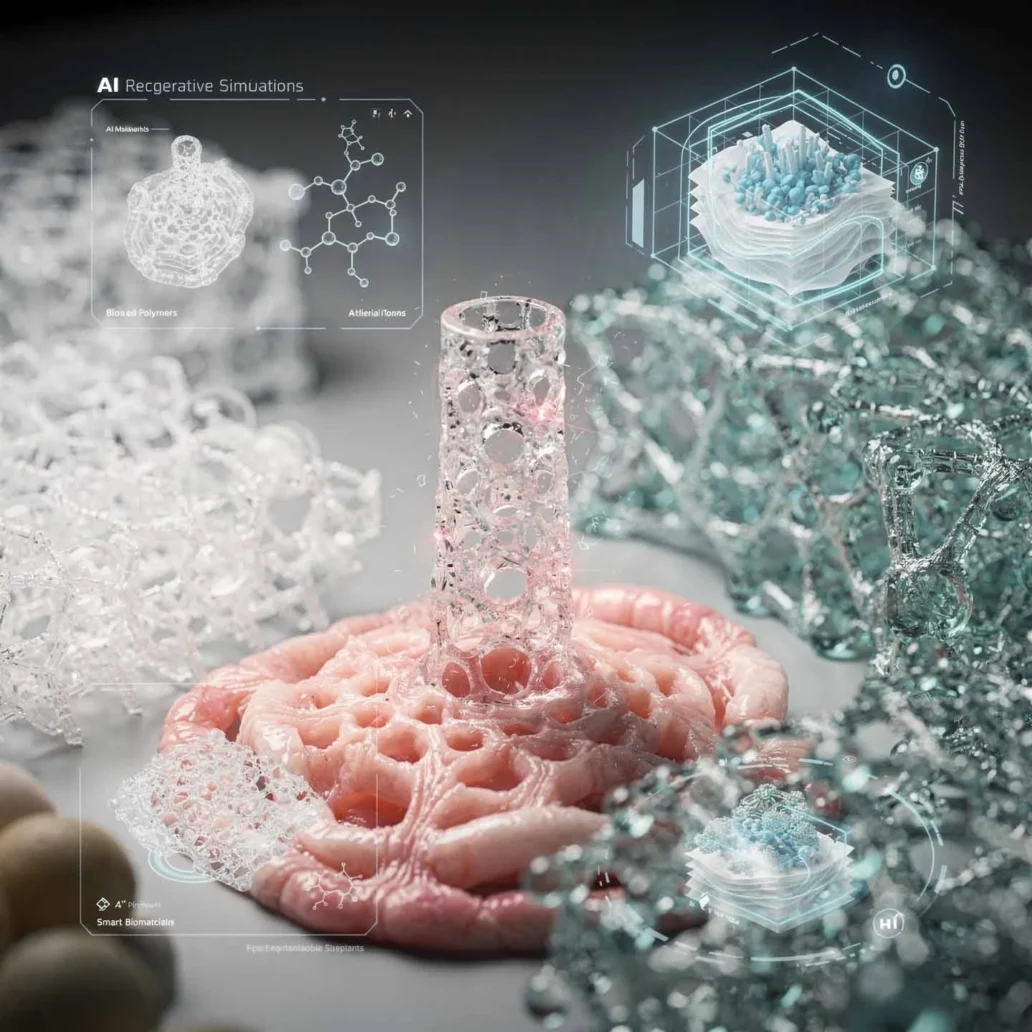
Patient-specific architectures produced through additive manufacturing with polymer and hydrogel bioinks such as PLGA, PCL, and tissue-mimetic hydrogels. Craniofacial repair, cartilage reconstruction, and spinal cage customisation are among the most advanced — explored further in Biofabrication & Clinical Applications of Biomaterials in Biomedical Engineering.
All three platforms are in active clinical development in 2026. The process, IP, and regulatory decisions being made now will determine who becomes a first-mover when these platforms reach commercial scale. For the broader context of how active and regenerative materials fit into this landscape, see Active, Adaptive, and Regenerative Biomaterials are Creating New Growth Frontiers.
From polymer selection to commercialisation: a strategic framework
Polymer scaffold design is well understood in the lab, but translating it into scalable, regulatory-compliant products remains the core challenge. Most delays and cost overruns arise during scale-up, sterilisation validation, shelf-life qualification, and process control.
FutureBridge 2026 report, Navigating the Biomaterial Challenge, outlines a structured approach covering material screening, techno-economic decisions, regulatory pathways, and ecosystem mapping, providing a full biomaterials strategy framework for R&D and innovation teams.