


The consumer doesn’t buy the ingredient…
From B2B to B2B2C: Helping ingredient companies get closer to the end consumer
Executive foreword
The best ingredient companies won’t just know their ingredients. They’ll know why consumers choose them.
Ingredient companies have long competed on science, technical service and reliable supply. Those strengths remain essential, but they no longer tell the whole story. Food manufacturers must improve nutrition without losing taste, respond to changing expectations without making products unaffordable, and innovate without adding unnecessary manufacturing risk. Ingredient suppliers understand these trade-offs. What they have not always understood as closely is the consumer who ultimately determines whether the finished product succeeds.
That is what B2B2C can change.
Not by turning suppliers into consumer brands, but by bringing consumer understanding into decisions about ingredients, formulations and product development. The opportunity is to move beyond asking what an ingredient can do and start asking what it can help a manufacturer achieve.
The consumer has always had the final say. The best ingredient companies will make sure that voice is heard before the product reaches the shelf.
Are ingredient companies solving the right problems or just the problems in the brief?
Many ingredient suppliers still lead with specifications, broad trend reports and application support. Their customers increasingly need something more useful: clarity on which consumer need, occasion and product format deserves investment. A technically sound formulation can fail because the occasion is wrong, the benefit lacks credibility, the sensory experience disappoints or the price is too high.
The B2B2C model keeps the manufacturer as the direct customer while using end-consumer evidence to improve decisions from opportunity selection through launch.
Three shifts matter:
- From ingredient specifications to consumer-backed opportunities. Connect technical performance to a defined consumer need and commercial proposition.
- From broad trends to specific choices. Prioritize needs by consumer, occasion, market and category.
- From responding to briefs to shaping them. Use insight, prototypes and validation before specifications are finalized.
This moves the supplier conversation beyond price per unit towards the value of the customer’s innovation opportunity.
The prize is not more consumer data. It is better decisions about what to develop, how to formulate it and when to invest.
From supplier to growth partner
| Traditional supplier posture | B2B2C growth partner posture | Business effect |
|---|---|---|
| Sell an ingredient and explain its performance | Frame a consumer-backed growth hypothesis, then connect it to an ingredient system | Moves the discussion from price per unit to value of the customer opportunity |
| Publish broad trend reports | Prioritize needs by consumer, occasion, market and category | Gives customers a clearer basis for portfolio choices |
| Respond after the technical brief is set | Shape the brief through insight, prototype and validation | Creates earlier access to projects and raises switching costs |
Credit: FutureBridge Analysis
Why does consumer proximity matter now?
Demand is fragmenting. Health, affordability, indulgence, sustainability and convenience increasingly influence the same purchase.
Five forces make consumer understanding more important to ingredient innovation.
01. More protein, more fiber, better health. But for whom?
Protein, digestive health, metabolic wellbeing and healthy ageing are shaping product development. Yet the same benefit can serve very different consumers and occasions.
A high-protein breakfast drink and a healthy-ageing nutrition product require different formats, sensory profiles and price points.
Strategic implication: Translate broad nutrition trends into specific consumer needs before selecting ingredients.
Reference: Innova Market Insights, Top Ten Trends 2026.
02. Consumers want healthier food. They still have to enjoy it.
Health benefits may encourage trial, but taste, convenience and affordability remain central to purchasing decisions.
A reduced-sugar product that loses its appeal, or a fiber-enriched snack priced beyond its audience, may struggle despite its nutritional merits.
Strategic implication: Optimize nutrition, sensory performance and cost together. Repeat purchase matters more than initial curiosity.
Reference: International Food Information Council, 2025 Food & Health Survey.
03. Change one ingredient, and you may change the whole product.
Protein enrichment can affect texture and flavor. Sugar reduction can change structure and shelf life. Added fiber may complicate processing.
Manufacturers increasingly need integrated solutions rather than isolated ingredient improvements.
Strategic implication: Combine ingredient science, application expertise and manufacturing knowledge to solve the complete formulation challenge.
04. More consumer data. But are decisions getting better?
Search, social media, retail intelligence and AI-enabled analysis can reveal emerging interests faster.
But online attention does not establish sustained demand. Signals need validation through consumer research, sensory testing and purchasing evidence.
Strategic implication: Use digital intelligence to identify opportunities, not substitute for commercial judgment.
Reference: Institute of Food Technologists, 2025.
05. A great formulation means little if it cannot be scaled.
Raw-material costs, supply volatility, traceability and environmental requirements influence product viability.
An attractive ingredient solution can lose its advantage if sourcing becomes unreliable or costs undermine the selling price.
Strategic implication: Bring supply resilience, sustainability and manufacturing economics into product development earlier.
Reference: FAO, Food Outlook, June 2026.
What are leading ingredient companies doing differently?
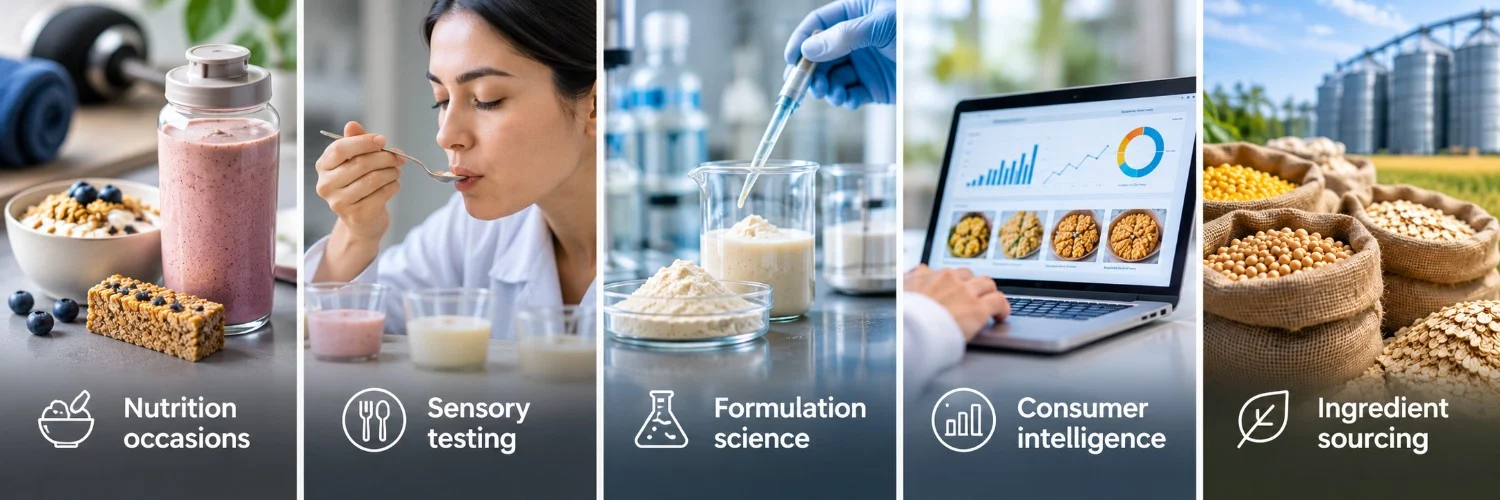
Several established suppliers are turning consumer intelligence into practical innovation services.
| Company example | Consumer proximity capability | What it signals |
|---|---|---|
| Kerry Taste Charts 2026 | Regional and category views of flavor momentum, supported by launch, retail-growth and proliferation measures, with sample-ready options | Trend intelligence becomes an activation tool for customer product development 2 |
| Givaudan Customer Foresight | Combines expert interpretation, big data and AI to anticipate consumer expectations and convert them into opportunity scenarios | Foresight is embedded before the customer brief is finalized 3 |
| ADM Outside Voice | Uses proprietary consumer studies to identify specific needs, including changing food and beverage expectations among users of anti-obesity medications | Consumer evidence can organize a portfolio of ready-to-formulate solutions 4 |
| IFF Immersive Experience Hub | Enables customers to conceptualize, test and refine ideas in simulated real-world environments | Co-creation extends from formulation into product experience and go-to-market decisions 5 |
| Ingredion CATALYST | Combines market relevance, application resources and ecosystem partners in a structured product-development service | The commercial offer can include an innovation process, not only ingredients 6 |
FutureBridge analysis
The basis of competition is broadening. Technical performance remains essential, but suppliers increasingly differentiate through the quality of the decisions they help customers make. The strongest positions combine consumer intelligence, application science, sensory evidence and commercial activation in one customer journey.
How can we turn consumer signals into products worth manufacturing?
The Consumer Translation Engine
A B2B2C capability should follow the decisions required to move an opportunity from signal to scale. Each stage produces a customer-facing output and an internal learning asset. This prevents consumer insight from becoming a stand-alone research activity.
| Stage | Decision to resolve | Customer output |
|---|---|---|
| 1. Sense | Which needs and occasions are gaining relevance? | Prioritized demand radar |
| 2. Translate | What must the product deliver? | Consumer-to-technical brief |
| 3. Co-create | Which formulation balances experience and economics? | Concepts and prototypes |
| 4. Prove | Is the concept credible, preferred and viable? | Sensory, claims and commercial evidence |
| 5. Scale | How should the offer adapt and improve? | Launch support and learning dashboard |
Each stage should produce a customer-facing output and reusable internal learning.
Consider protein enrichment
Consumers may value added protein, but repeat purchase depends on taste, texture and an acceptable price premium.
- The manufacturer’s decision is not simply how much protein to add. It is which consumer occasion and format can support the benefit without unacceptable compromises.
- The supplier translates that decision into a protein target, mouthfeel standard, flavor profile, ingredient-list requirements, processing window and unit-cost ceiling.
- Blind sensory preference, benefit credibility, purchase testing, stability and scale-up trials then help establish whether the concept is viable.
The differentiator is translation quality: turning a credible demand signal into measurable product requirements and a commercially workable solution.
| Stage | Decision to resolve | Customer-facing output | Value to the ingredient company |
|---|---|---|---|
| 1. Sense | Which behaviors, needs and occasions are gaining relevance in this category and market? | Prioritized demand radar with evidence strength, momentum and strategic fit | Earlier view of attractive demand spaces and stronger account conversations |
| 2. Translate | What must the product deliver for the target consumer, occasion and price point? | Technical design brief covering benefit, sensory target, format, cost, process, claims and regulatory constraints | Connects insight directly to the ingredient portfolio and reveals capability gaps |
| 3. Co-create | Which product system can deliver the intended experience and business economics? | Concept sprint, prototypes and formulation options with explicit trade-offs | Moves the supplier upstream in the customer’s innovation process |
| 4. Prove | Is the concept preferred, credible, manufacturable and commercially viable? | Sensory and concept validation, claims support, manufacturability assessment and business case | Builds evidence for adoption and reduces late-stage failure risk |
| 5. Scale | How should the offer adapt by market, channel and customer portfolio? | Launch kit, regional variants, sales story and post-launch learning dashboard | Creates repeatable solution platforms and recurring customer engagement |
Not every consumer signal deserves investment
Different forms of evidence inform different stages of product innovation:
- Search and social trends: Identify emerging consumer interests and unmet needs, but do not confirm sustained demand.
- Consumer surveys and interviews: Reveal purchase motivations, desired benefits and acceptable trade-offs, although stated preferences may differ from actual behavior.
- Sensory and concept testing: Evaluate product appeal, taste, texture and overall consumer acceptance before commercialization.
- Purchase and pricing tests: Assess willingness to buy and perceived value at the intended price point.
- Retail and repeat-purchase data: Validate real-world demand, product performance and sustained consumer adoption.
The strategic imperative: Use early signals to identify opportunities but require stronger consumer and commercial evidence before committing significant investment.
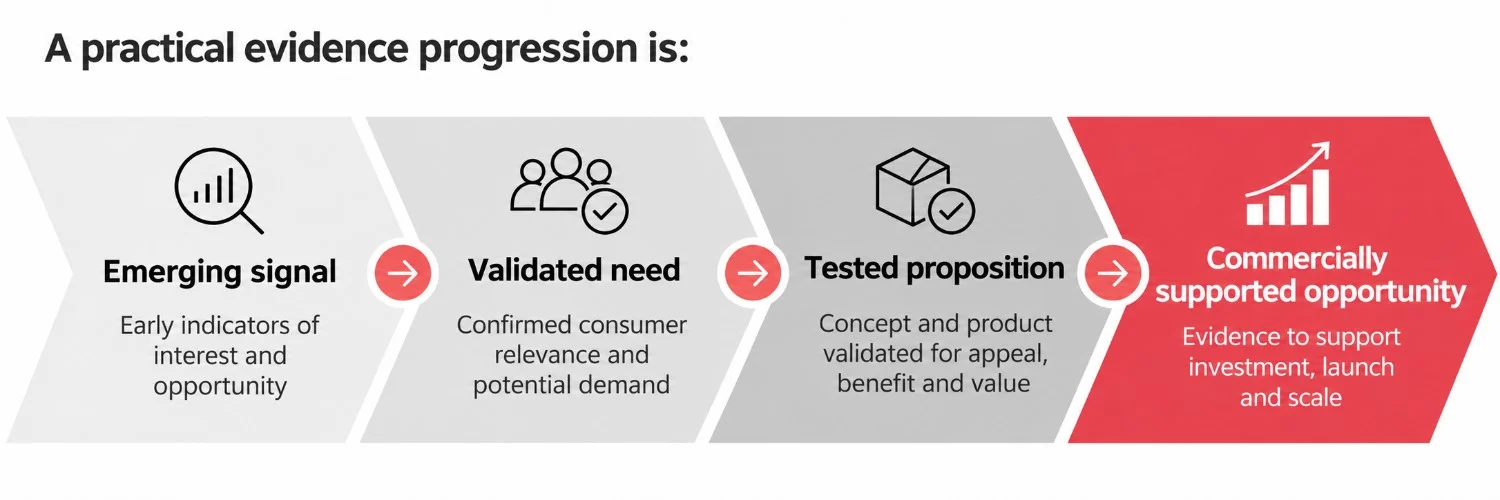
The strength of evidence should rise with the size of the investment. A social media trend may justify exploration. It should not, by itself, justify a new production line.
Suppliers build credibility when they distinguish what the evidence proves from what still needs testing.
How should ingredient companies package consumer proximity?
The original three-tier commercial model provides a practical starting point.
| Partnership tier | Value proposition |
|---|---|
| Enhanced supplier | Help customers interpret trends and identify relevant ingredient options through demand intelligence, category snapshots and application guidance. |
| Solution partner | Support a defined opportunity from brief to validated prototype through concept development, sensory work and claims support. |
| Growth partner | Collaborate with strategic customers on recurring research, innovation pipelines and post-launch learning. |
Five customer-facing services can support these relationships:
- Demand Radar: Rising consumer needs ranked by evidence strength and category relevance.
- Category Opportunity Map: Attractive need-states, occasions and market gaps.
- Concept Sprint: A focused cycle from opportunity to prototype.
- Evidence Pack: Sensory, scientific, regulatory and commercial support for decisions.
- Launch Learning Dashboard: Market feedback and reformulation priorities.
Smaller customers may need targeted insight and technical guidance. Strategic accounts may justify deeper co-creation.
The commercial offer should reflect the value of the customer decision and not simply the volume of research delivered.
Getting closer to consumers must not mean getting between suppliers and customers
A coordinated operating model should bring together the right capabilities while protecting customer relationships:
- Consumer and category insight hub: Manages research standards, consumer intelligence and shared learning across markets.
- Category and market teams: Translate consumer opportunities into locally relevant customer priorities.
- Application R&D: Converts consumer needs into formulations, prototypes and scalable ingredient solutions.
- Sales and key accounts: Align innovation opportunities with customer needs and convert them into commercial projects.
- Science, regulatory and legal teams: Establish evidence standards, validate claims and ensure regulatory compliance.
Customer trust and governance
Customer trust remains fundamental. Manufacturers retain ownership of their brands and consumer relationships, while research permissions, confidentiality, intellectual property and data-sharing terms must be agreed before collaboration begins.
The principle: Consumer proximity should strengthen the supplier–manufacturer relationship, not create channel conflict.
Readiness scorecard – The action agenda for F&B players
F&B players can use this scorecard to assess how effectively they connect consumer demand with ingredient and product decisions. Score each capability from 1 to 5 using evidence from live projects rather than stated ambition. The total score identifies the next set of management actions.
| Capability | What F&B players should put in place | What is driving the need | Score 1–5 |
|---|---|---|---|
| Consumer sensing | A category and consumer demand radar, refreshed at a defined cadence and segmented by need-state, occasion, market and channel | Demand is fragmenting rapidly, while social, retail and launch signals move faster than annual research cycles | _____ |
| Translation into briefs | One consumer-to-technical brief covering the target user, occasion, benefit, sensory standard, format, price, claims and process constraints | Ambiguous briefs create late-stage rework and disconnect consumer relevance from formulation choices | _____ |
| Customer co-creation | Joint opportunity and prototype sprints that involve insight, application R&D, science, sales and the customer before specifications are fixed | Customers need faster decisions and access to capabilities that rarely sit within one organization | _____ |
| Evidence and validation | A shared test plan with sensory, benefit credibility, willingness-to-pay, claims, manufacturability and scale or stop thresholds | Greater claims scrutiny and pressure on innovation returns require stronger evidence before launch | _____ |
| Commercialization and learning | Repeatable solution platforms, regional adaptation rules, launch support and a feedback loop that updates future opportunity choices | Local preferences vary, and post-launch learning is often lost rather than reused across markets and accounts | _____ |
How to assign the score
| 1. Ad hoc Individual-led and reactive |
2. Emerging Pilots exist but are inconsistent |
3. Defined Common method in selected areas |
4. Integrated Embedded in innovation decisions |
5. Differentiating Scaled and commercially distinctive |
Turn the total score into action
| Total score | Management priority | Actions to take next |
|---|---|---|
| 5 to 12 | Build the foundation | Name an executive owner; adopt the consumer-to-technical brief; choose two categories and three anchor customers; baseline cycle time and conversion |
| 13 to 19 | Prove and standardize | Run 90-day co-creation pilots; set research and evidence standards; train account and R&D teams; track which customer decisions change |
| 20 to 25 | Scale the advantage | Productize the insight and co-creation offer; embed it in account planning; connect launch learning to the demand radar; define commercial terms |
Commercial performance should be tracked alongside readiness: opportunity-to-project conversion, speed to validated prototype, prototype-to-launch conversion, project profitability and repeat customer business.
For smaller suppliers, start with one category, a few anchor customers and a focused co-creation pilot. Larger companies can standardize successful methods across markets and strategic accounts.
Immediate management move
Score the five capabilities, identify the two most consequential gaps and assign owners and 90-day improvement targets.
Where will ingredient companies create value next?
The next phase of competition in the ingredient industry will increasingly be shaped by who influences innovation decisions, not simply who supplies the formulation. As consumer expectations fragment and product development becomes more complex, the ability to identify commercially attractive opportunities early could become a significant source of differentiation.
From FutureBridge’s perspective, three shifts will redefine where ingredient companies create and capture value:
- From responding to briefs to shaping innovation priorities: Influence which consumer opportunities manufacturers pursue before formulation begins.
- From supplying ingredients to delivering integrated solutions: Combine ingredient science, consumer insight and application expertise to solve complex product challenges.
- From proving technical performance to demonstrating commercial impact: Measure success through faster commercialization, stronger product acceptance and profitable customer growth.
The strategic opportunity is to turn these capabilities into a repeatable competitive advantage. Ingredient companies that embed consumer intelligence into R&D, category strategy and customer collaboration can gain earlier influence over innovation pipelines, become harder-to-replace partners and capture greater value from co-developed solutions.
The question is no longer just who wins the formulation brief, but who helps determine which opportunities are worth pursuing.
Contact FutureBridge experts to identify high-potential consumer needs, translate them into actionable ingredient and formulation briefs, and develop validated, commercially viable solutions with your food and beverage customers.
Frequently asked questions
What does B2B2C mean for food ingredient companies?
B2B2C is a business-to-business-to-consumer approach in which ingredient suppliers use end-consumer insights to help food and beverage manufacturers develop more relevant products. Manufacturers remain the direct customers, while consumer evidence informs ingredient selection, formulation, innovation priorities and commercialization.
Why is consumer proximity becoming important for ingredient suppliers?
Consumer proximity helps ingredient suppliers understand changing expectations around nutrition, taste, convenience, affordability and sustainability. It allows suppliers to identify unmet needs earlier, develop more relevant ingredient solutions and support customers in making better product innovation decisions.
How can ingredient companies translate consumer insights into product innovation?
Ingredient companies can use a five-stage process: Sense emerging needs, Translate insights into technical requirements, Co-create formulations, Prove consumer and commercial viability, and Scale successful solutions. This connects consumer intelligence with application science, sensory validation and manufacturing economics.
What are the commercial benefits of a B2B2C strategy?
A B2B2C strategy can help ingredient suppliers influence innovation briefs earlier, strengthen customer partnerships, improve opportunity selection and differentiate beyond ingredient specifications. Its commercial value should be measured through project conversion, speed to validated prototype, successful launches and profitable customer growth.
How should ingredient suppliers validate consumer demand before investing?
Suppliers should combine early signals from search, social media and market intelligence with consumer research, sensory testing, pricing studies and purchasing evidence. Validation requirements should become more rigorous as an opportunity approaches commercialization, helping distinguish emerging interest from sustainable demand.
How can ingredient companies begin implementing B2B2C capabilities?
Ingredient companies can begin by assessing five capabilities: consumer sensing, insight-to-brief translation, customer co-creation, evidence and validation, and commercialization learning. A focused pilot involving one category, selected customers and clear 90-day objectives provides a practical starting point before wider implementation.