


Next-generation Wireless Technologies – Changing the Automotive Ecosystem
Introduction
The automotive industry is going through a profound transformation over the last decade. One of the significant contributors to this transformation is vehicle connectivity through wireless technologies. In this transformation, wireless technologies have played an essential role in enabling vehicle connectivity applications in telematics, ADAS, infotainment, and vehicle diagnostics.
Automakers initiated the application of wireless technologies in the vehicle by locking and unlocking of doors using infrared. Later, the adoption of secure and encrypted radio-frequency enabled automatic garage door opening and closing, with the automobiles’ door lock/unlock mechanism.
Consumers realized the benefits of wireless technologies such as convenience, comfort, and improved safety with Bluetooth technology, where wirelessly operating heaters and air-conditioners of the vehicle became seamless. Now, Bluetooth technology is essential for infotainment systems apart from providing vehicle diagnostics to users via connected apps.
Further, the Wi-Fi provides an extensive data transfer capability that has enabled over the air software updates and seamless transition from the drivers’ smartphones to the car they are driving. In electric vehicle charging infrastructure, Wi-Fi shows potential in optimizing energy transfer from the electric grid to cars and further facilitating convenient payment systems for car battery charging.
In recent years, 4G LTE has been an enabler for telematics services, wherein communication between vehicles and other vehicles (V2V), infrastructure (V2I), pedestrians (V2P), and the network (V2N); referred vehicle‐to‐everything (V2X) communications has become possible.
With the further adoption of wireless technologies such as Bluetooth, Wi-Fi, and LTE and the emergence of new wireless technologies such as 5G, Bluetooth Low Energy, Li-Fi would further revolutionize the vehicle connectivity. These emerging technologies would ensure vehicles’ seamless operations as per the demand, leading to commercial adoption of autonomous passenger vehicles.
This evolution in wireless technologies has propelled traditional mobility to the current connected car environment, which will sooner be driven into an autonomous climate with developments in emerging wireless technologies.
During this transformation, auto-makers, ICT companies, and other stakeholders will look into ways to collaborate to provide the best services. These collaborations will result in the evolution of a new ecosystem having different industries that need to cooperate and compete simultaneously to address new business opportunities.
Current & Future Technologies
If we look into the current scenario, the modern automotive industry is already a wireless technology hub. These technologies mainly find their applications in infotainment systems, driver assistance, vehicle connectivity within the external environment (such as V2V and V2P), and vehicle security and safety.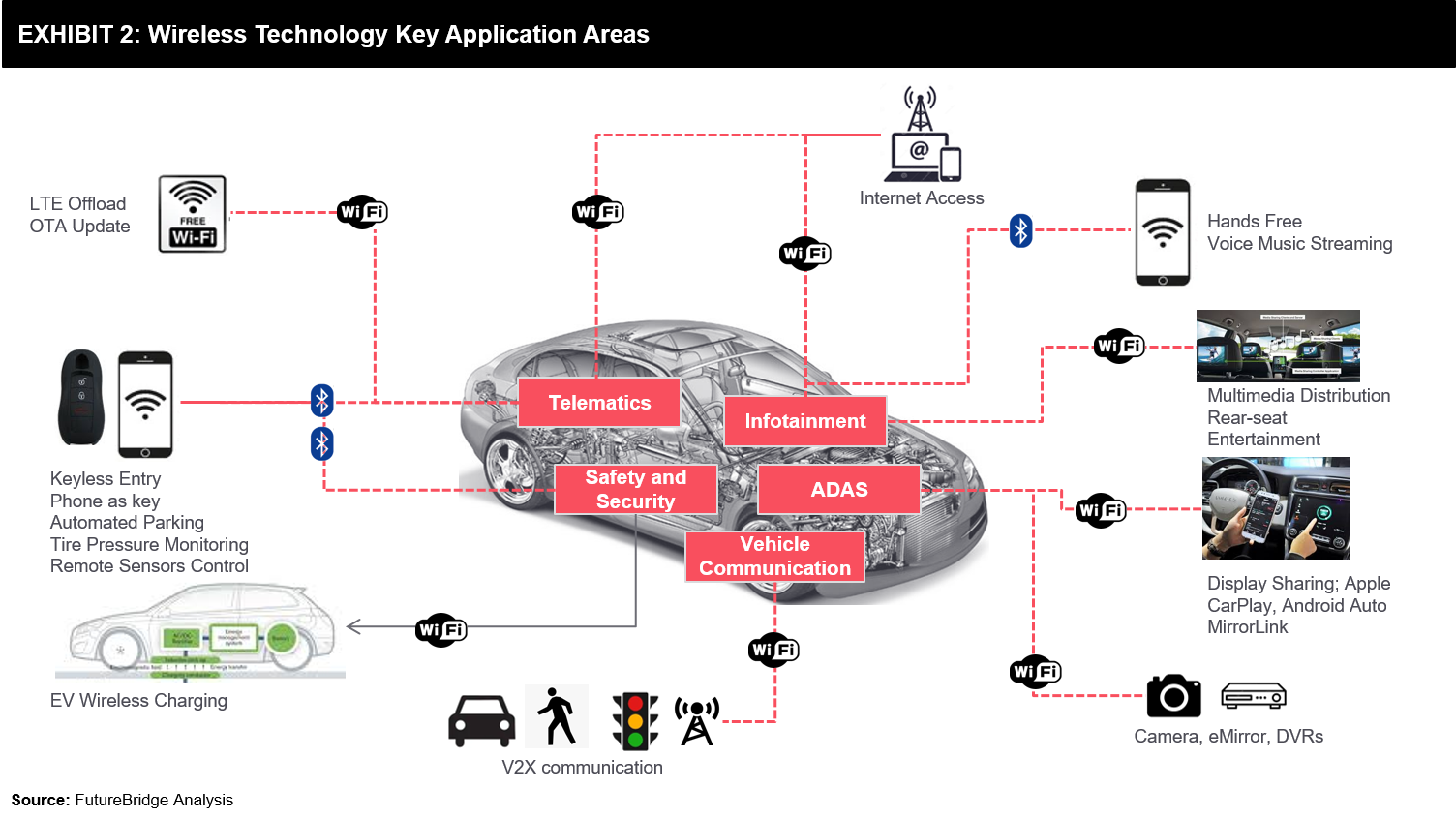
Technologies like Bluetooth, ZigBee, UWB, Wi-Fi, NFC, Infrared, and Cellular (3G, LTE, and 4G) have already reached a level of maturity. However, limitations (such as low bandwidth, short-range, and consumption of high power) have resulted in the need for further investigation and improvement. Below are some of the emerging and nascent stage technologies in the automotive sector.
5G Network Connectivity
5G is still at a nascent stage, and there are investments across the globe for the adoption of this technology. Currently, safety challenges in vehicle autonomy are an issue, and for level 5 to be a reality, 5G will play a crucial role. Though there are alternative technologies like 4G and LTE, 5G is expected to reduce latency and increase reliability, ensuring real-time updates and seamless connectivity in vehicles both within the internal and external environments. According to Gartner, the share of 5G-connected cars that are actively connected to a 5G service will grow from 15% in 2020 to 74% in 2023, reaching 94% in 2028.
European Commission has taken various initiatives to promote 5G for the automotive industry. European Commission announced these initiatives as early as 2017; however, each technology needs to develop. Hence, once developed, these initiatives will play a crucial role in connectivity wireless technologies in automotive.
- The setting of EATA – The European Automotive Telecom Alliance, this commission intends to jointly develop and strengthen the digital initiatives for connected and autonomous mobility.
- 5G Automotive Alliance – This alliance has numerous members across the automotive ecosystem, including OEMs, Tier suppliers, electronics & software providers, where the primary goal is to promote 5G technology across Europe. Some sample members include:
 CAR2CAR Consortium – This consortium has resulted in a partnership among OEMs (like Hyundai, GM, Volvo, and Volkswagen) supported by associate members, including Tier suppliers. This consortium aims to focus on wireless communication applications for all vehicles, across borders and brands.
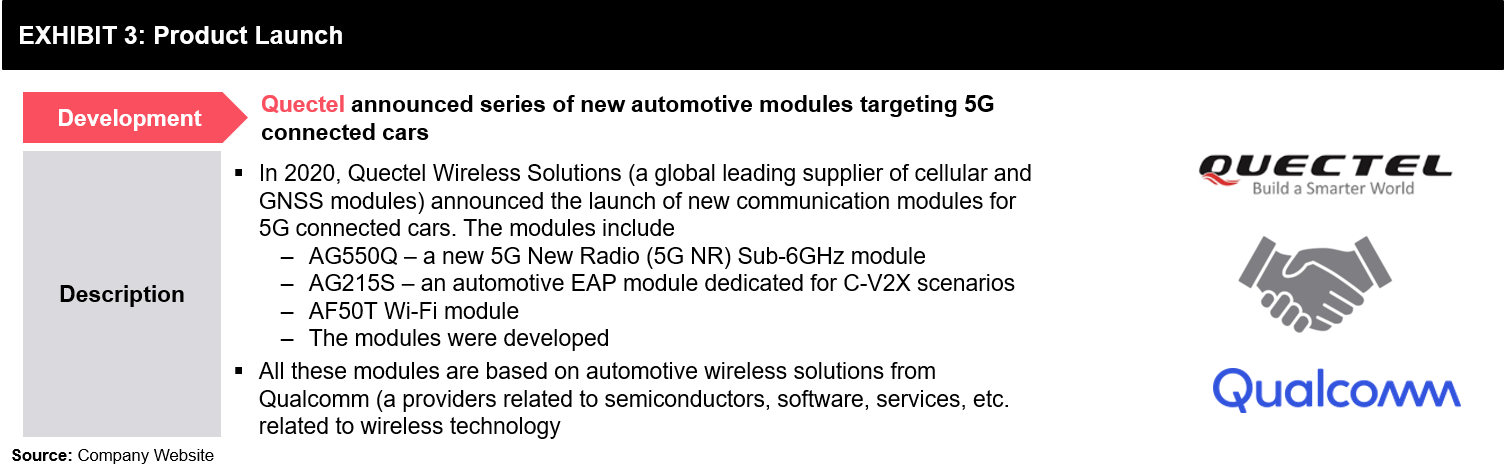
A recent product launch (refer to Exhibit 3) indicates the initiatives taken by various automotive ecosystems to focus on 5G connected cars.
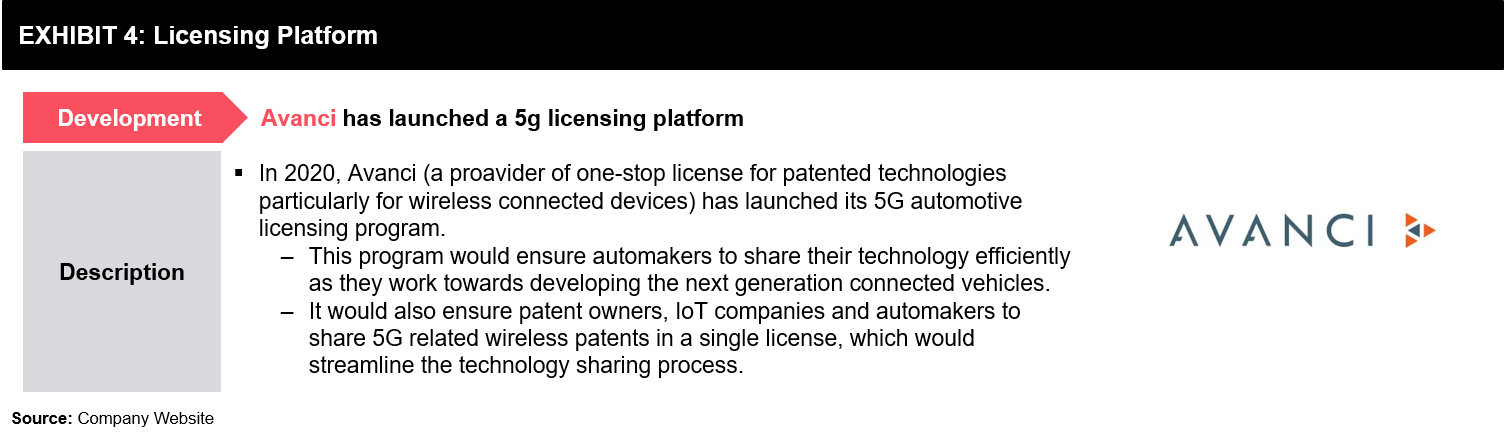
To promote 5G technology, companies are also launching licensing programs to ensure automakers share 5G related wireless patents in a single license (refer to Exhibit 4).
 Bluetooth Low Energy
Due to extensive electronics architecture in connected vehicles, low-power is one of the critical requirements, and hence there is an increasing shift toward Bluetooth low energy (BLE) wireless technology. Players across the automotive ecosystem are working towards this technology extensively for applications such as phone-as-a-key, cable replacement for body applications, battery-management systems, infotainment, and wireless sensors.
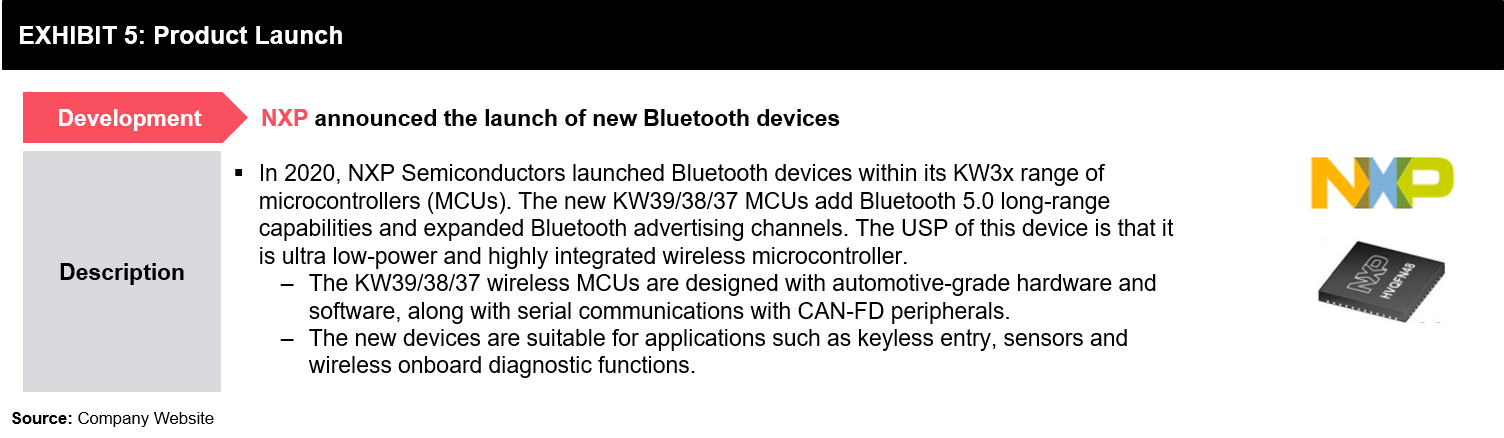
BLE started with the phone-as-a-key feature in automotive; however, it can be used for in-vehicle infotainment systems, where currently high power-consuming connectivity devices such as 4G and Wi-Fi are being used. Infotainment systems require low power consumption amounting to <1 mA when the car is switched off. This is a crucial factor for automakers to look for other connectivity options, such as low-power wireless microcontrollers, system-on-chips, and other devices with high standby current. BLE can be a good option for this, which will allow the vehicle to stop high current consuming components, and the car can start when required. This technology also offers quality and reliability. This technology already has used cases to enable the telematics box or head-unit display unit and determine if the car requires over-the-air software updates or other diagnostic functions. Please refer to Exhibit 5 for a recent product launch, ensuring BLE devices that can be designed to consume low power and still have long-range capabilities
 .
.Li-Fi
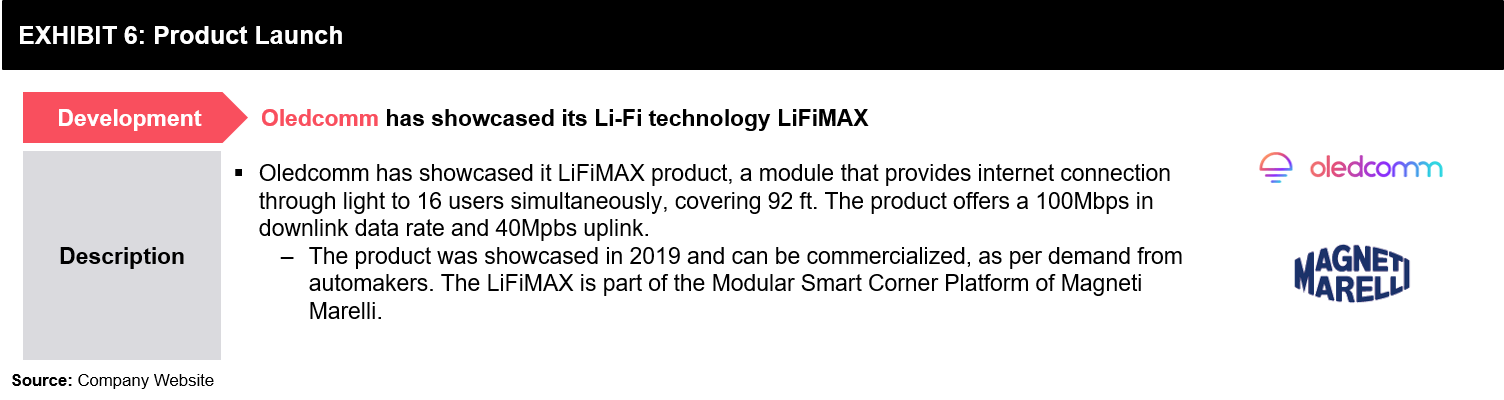
Li-Fi is a communication system that uses light to transmit data at high speeds over visible light, ultraviolet, and infrared spectrums. Light travels at breakneck speeds, allowing Li-Fi connections to occur almost immediately, thereby improving internet connectivity. This improved connectivity is expected to enhance vehicle-to-vehicle and vehicle-to-infrastructure communications drastically and can be an alternative to Wi-Fi in automotive vehicles in the future. This technology is expected to make inroads in the automotive applications and is expected to gather a 3–5% market share (of the total Li-Fi market) by 2030. An example where this is being tested successfully is provided in Exhibit 6.
NB-IoT
This technology (part of the 5G family) is a Low Power Wide Area Network (LPWAN) radio technology, enabling a wide range of cellular devices and services. This technology penetration is expected to increase in automotive with an increase in demand for vehicles’ telematics. This technology’s benefits, such as low power consumption, coverage, and low component costs, would further grow. Automakers are expected to focus on this technology mainly for fleet tracking, and it can be a crucial solution for tracking vehicles in the shared mobility business model. This technology can also be useful for monitoring insurance services, where an on-demand insurance coverage model is being used. On-demand insurance initiates coverage as soon as the vehicle starts and ends when the car is shut down. As a result, the vehicle user pays only insurance premium based on its actual use (refer to Exhibit 7).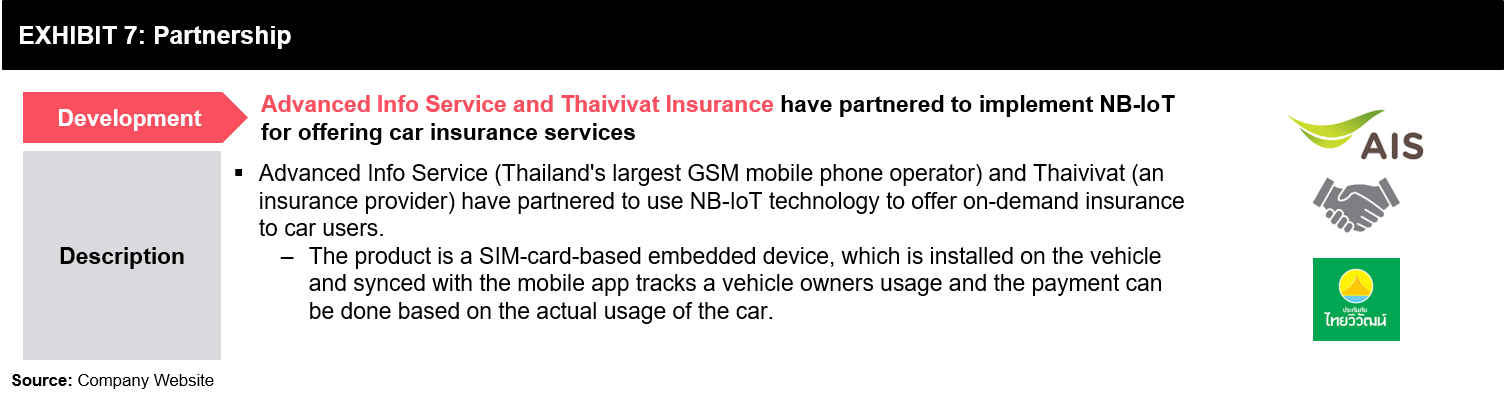
Wireless Technology Enabling Automotive Ecosystem Transformation
Need for collaboration
In the last few years, wireless technology has demonstrated various possibilities to improve connectivity by enabling arrays of new applications and services and resulted in more efficient car-sharing, location-based advertising, and better passenger safety.
To explore these wireless technologies’ potential new applications, automakers need new platforms capable of real-time analytics and strong integration with the hardware generating a vast amount of data. This requirement of additional capabilities has transformed the traditional mobility ecosystem into a much more complex ecosystem, adding multiple entities to help realize the full benefit of these wireless connectivity technologies. Moreover, many applications’ success requires interactions across this expanded ecosystem involving OEMs, ICT companies, and multiple third-party entities, such as insurance companies or service providers.
While automakers play a pivotal role in unlocking the value of these wireless technologies, most of them face the challenge of capability and talent in cloud network integration, data management, machine learning, etc. Additionally, many players struggle to build successful business models around data and connectivity, mainly due to organizational reasons.
There is no player in the traditional ecosystem with all the access, assets, and competence required to build these applications alone. Hence, to deploy these applications successfully and realize the full potential of wireless technologies, it will be essential to expand the current ecosystem.
The emergence of a new mobility ecosystem
Traditionally, automakers have worked hand in hand, mostly with tier-one suppliers, but today, there is an emergence of a broader ecosystem involving multiple entities.
Mobility customers are becoming more demanding of services not limited to infotainment but many advanced services such as advanced driver support and safety. To cater to these demands, automotive manufacturers have started exploring the potential of the various wireless technologies, operating systems, real-time analytics, and content platforms by collaborating with players who are not currently part of the traditional mobility ecosystem.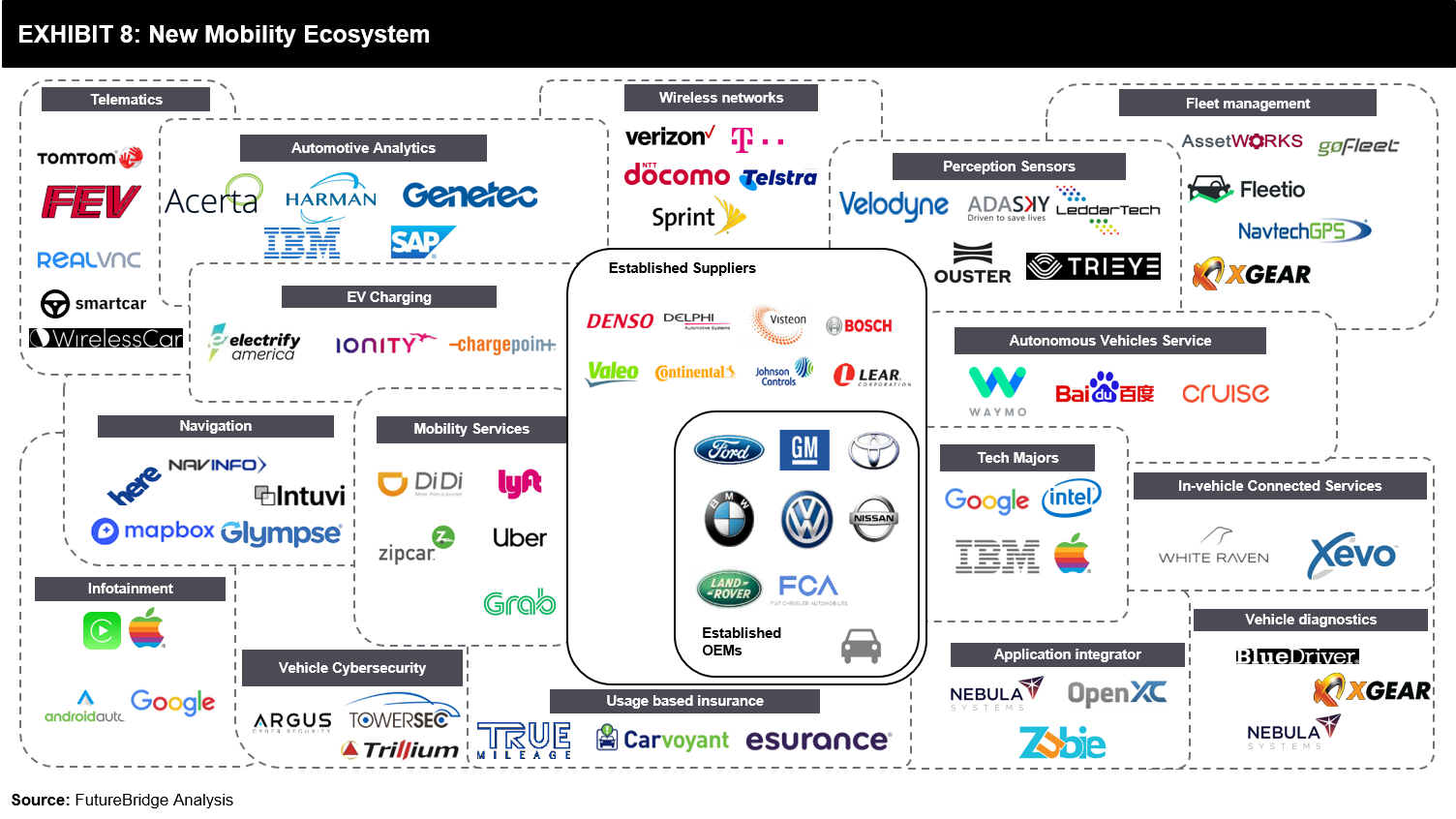
The new mobility ecosystem is very dynamic and fast-evolving. It is adding new entities based on the new complex requirements of a future customer.
This new evolving ecosystem is also experiencing the entry of high-tech players in the mobility market. Simultaneously, existing players are forming new partnerships with entities that are currently not part of the mobility ecosystem. On the other hand, some tier-two suppliers are also offering products and services directly to OEMs, thus sidestepping tier-one companies.
Currently, automakers have reasonable control over the end customer and also over the car. However, to stay ahead in connectivity applications, automakers have to reevaluate their roles in the ecosystem.
Automakers will experience technical challenges in the new mobility ecosystem that include software integration, cyber-security issues, and other complicated connectivity platform management issues. They will have to overcome these issues by collaborating with mobile-network operators, telecom equipment manufacturers, mobility service providers, and tech companies. Business leaders from various industries who are becoming part of this new mobility ecosystem are looking to expand their role and find ways of handling the implications of this transformation, resulting from emerging wireless technologies in mobility.
References
- Automotive Wireless
- How connectivity is transforming the automotive ecosystem
- Applications of wireless technology in smart vehicles
- Quectel Unveils New Automotive Modules to Support the Auto Industry in the 5G Era
- Avanci Launches 5g Licensing Platform For The Internet Of Things
- LiFiMAX High speed internet through invisible light
- NB-IoT Paving Way For Unique On-Demand Car Insurance Services