


Basic Overview of Cultured Meat
Cultured meat is produced without pain by harvesting muscle cells from a living cow. Manufacturers then feed the cells with culture media so that they can multiply to produce muscle tissue, which is the important component of meat that people eat. It is biologically the same as meat tissue that comes from a cow.
Cultured meat is also known as clean meat, lab-grown meat, cellular agriculture, or in-vitro meat.
The Food and Agriculture Organization of the United Nations (FAO) estimated that meat demand will increase by more than two-thirds in the next 40 years, while the current methods utilized to produce meat are not sustainable. It is said that, in the future, due to the increasing demand for meat, prices will also increase.
Traditional meat produced using livestock contributes to global warming through methane emissions, which can create a 20-fold increase in greenhouse gas emissions. Therefore, an increase in demand could significantly increase methane, carbon dioxide, and nitrous oxide emissions, contributing to biodiversity loss.
Cultured meat is a comparatively more sustainable option that could change the way meat is produced and consumed.
The cultured meat sector aims to disrupt the conventional way of producing meat by using animals. This goal can help decrease the number of animals killed for food while supporting a more sustainable and ethical global food system.
Producing cultured meat significantly bypasses the animal itself, addressing concerns around animal slaughter and cruelty. Early research was funded in part by People for the Ethical Treatment of Animals.
Furthermore, it is not only animals that may benefit from cultured meat; the planet may also benefit in several ways. With the expectation that the world population will surge past nine billion by 2050, and with meat production contributing a major share of global warming, cell-cultured meat may offer one potential solution to mitigate these challenges in the future.
In 2018 research, Hanna Tuomisto, a professor at the Helsinki Institute of Sustainability Science, compared the environmental impacts of cultured meat with plant-based foods. The research showed that cultured meat has higher greenhouse gas emissions and energy use than unprocessed plant-based protein crops, such as beans and peas. However, emissions were comparable with processed vegetarian meat substitutes.
She also mentioned that cell-cultured meat is expected to use less water and land and may produce fewer overall greenhouse gases, which could lead to a positive environmental impact.
Apart from this, many companies are working to bring cultured meat out of the lab and into factories, and eventually to global markets. Various companies have also worked extensively to address flavour issues, and consumers are increasingly satisfied with the taste.
The technology used for producing cultured meat is based on tissue engineering techniques. Various other technologies are also being developed and utilized by many food start-up companies.
Many emerging start-ups are producing cell-cultured meat to satisfy increasing demand and reduce environmental impact.
In June, an Israeli company, Future Meat, announced the opening of a facility that would make meat equivalent to 5,000 hamburgers a day. The company also hoped to make its product available in the US by 2022.
Another company, Eat Just, is already marketing chicken nuggets in Singapore. Singapore was also the first country to approve cell-cultured meat for sale.
How Is Cultured Meat Made?
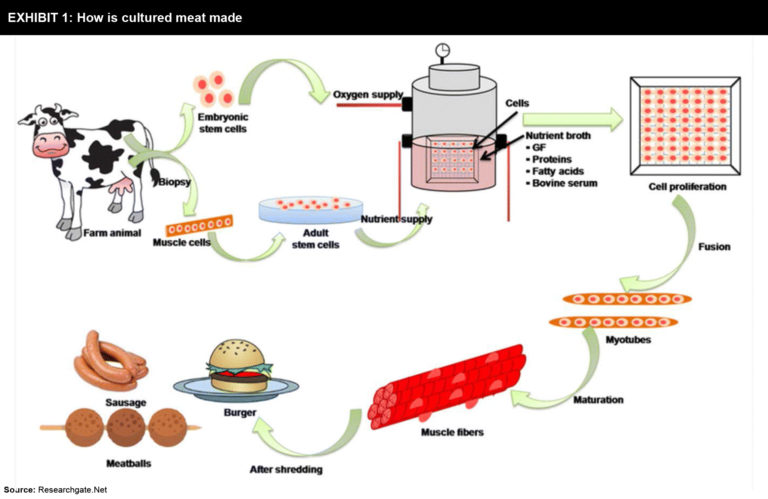
Technological challenges in the production of Cultured Meat:
There are some production technology challenges to be addressed for cultured meat to go into the market. In general, the production process can be divided into three parts such as cell collection, cell culture, and cultured meat production. In the cell collection process, the challenge is a method for obtaining the living cells. And in cell culture, the method for developing and mass-production of culture media as well as other materials, and in cultured meat production, the challenge is a method for processing. It was said that the biggest challenge among them is developing methods and mass production of cultural media. The start-ups which are developing cultured meat do not carry out the entire production process. Many companies now have come up with a specialized method for the development and mass production of culture media. This indicates that even though many have pointed out challenges regarding the method of developing and mass-producing cultured fluid, the optimal solution has not yet been found.
Other technological challenges:
The main challenge is the texture of the meat which comes from the tissue contained in the muscles. The cultured meat produced using bioreactors does not contain muscle tissue. Only paste-like cells are available. Therefore, with existing plant-based meat substitutes, cultured meat can only be produced into products that use minced meat, like hamburgers. The problem which is needed to be solved is the reproduction of muscle tissue. Many studies are ongoing to develop a technology that can recreate the original texture of meat, like steak meat. In 2019, Nissin Foods Holding, collaborated with the University of Tokyo, to make dice steak-shaped bovine muscle tissue and they were succeeded. Many emerging start-ups have produced mushroom fiber scaffolding to provide a similar texture as original meat.
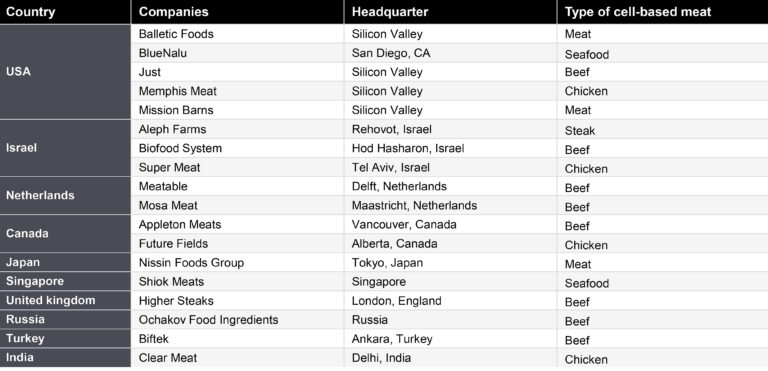
A representative list of companies producing cultured meat all over the world:
Eat Just
- Eat Just is a company that produces plant-based egg substitutes
- The plant-based egg products are made from mung bean
- Offers slaughter-free frittatas, omelets, French toast
- The company utilizes cutting-edge science and technology to make healthier, and more sustainable foods
The company produces plant-based products by using key ingredients such as mung beans. It contains proteins that taste and scrambles like an egg. Mung bean is a sustainable crop, which is rich in potassium, magnesium, and dietary fiber. JUST Egg obtains its egg-yolk golden color naturally by using turmeric and carrot. The products are cholesterol-free, Non-GMO, and contain no artificial flavors. The company has raised USD 97 million in funds for cultured meat production.
Benefits of Cultured Meat:
- Production of cultured meat uses 99% less space, 45% less energy, and 96% fewer greenhouse gas emission
- It reduces food-borne diseases
- Improved nutritional profiles, for example, by replacing saturated fats with unsaturated fats, making eggs without cholesterol, or making lactose-free milk
- Better animal welfare
- Sustainable meat production
Regulatory updates of cultured meat
Singapore becomes the first country to approve the sale of lab-grown meat. Singapore (SFA) approved the sale of cultured meat products. The SFA approval of the product includes cultured chicken, which is produced by the US-based Eat Just company. The company has announced that the product will be produced with local partners under its new brand GOOD Meat. It will debut under the GOOD Meat brand as chicken bite along with breading and seasoning in a single restaurant. The SFA also stated that the chicken produced by Eat Just met its safety standards for use in nuggets, covering the way for commercial launch in Asian cities or states. Furthermore, Eat Just plans to build the first-ever cultured meat facility in the Middle East and Northern Africa (MENA) region, in partnership with Doha Venture Capital (DVC) and Qatar Free Zones Authority (QFZA). The new facility will also include a protein processing facility for its plant-based egg. The facility will be situated in Umm Alhoul Free Zone, which is regulated by QFZA. It will also offer direct access to Hamad Port, Qatar’s primary seaport. The QFZA and Ministry of Public Health proposed that they will give regulatory approval for GOOD Meat’s cultivated chicken very soon. The organization has already allowed an export license for the product.
References
- How Cultured Meat is Made Image
- What is Cultured Meat
- What is cell cultured meat and when can you try it?
- The Myth of Cultured Meat : A Review
- Lab-Grown Meat: What is cultured meat and how it is made?
- Cultured meat production technology : Challenges and future development
- Lab Grown meat companies
- Cultured meat : state of art and future
- Eat Just
- Singapore becomes first country in world to give approval for sale of lab-created meat
- Lab-grown meat: Cleared in Singapore, an emerging alternative worldwide