


What the Middle East conflict means for automotive supply chains and vehicle economics
The Gulf energy crisis is no longer a regional disruption. It is actively reshaping automotive cost structures, supply chain reliability, and EV economics across global mobility systems. Since late February, the Middle East conflict has evolved from a geopolitical event into a system-level shock. Energy prices remain elevated, LNG flows are constrained, and shipping through critical corridors such as the Strait of Hormuz has become slower, more expensive, and less predictable. Air cargo routes through Gulf hubs are operating below optimal capacity, and insurance premiums for maritime transit have increased. The system is still functioning, but the conditions under which it operates have fundamentally changed.
For automotive players, this is not a temporary spike. It is a shift in the baseline.
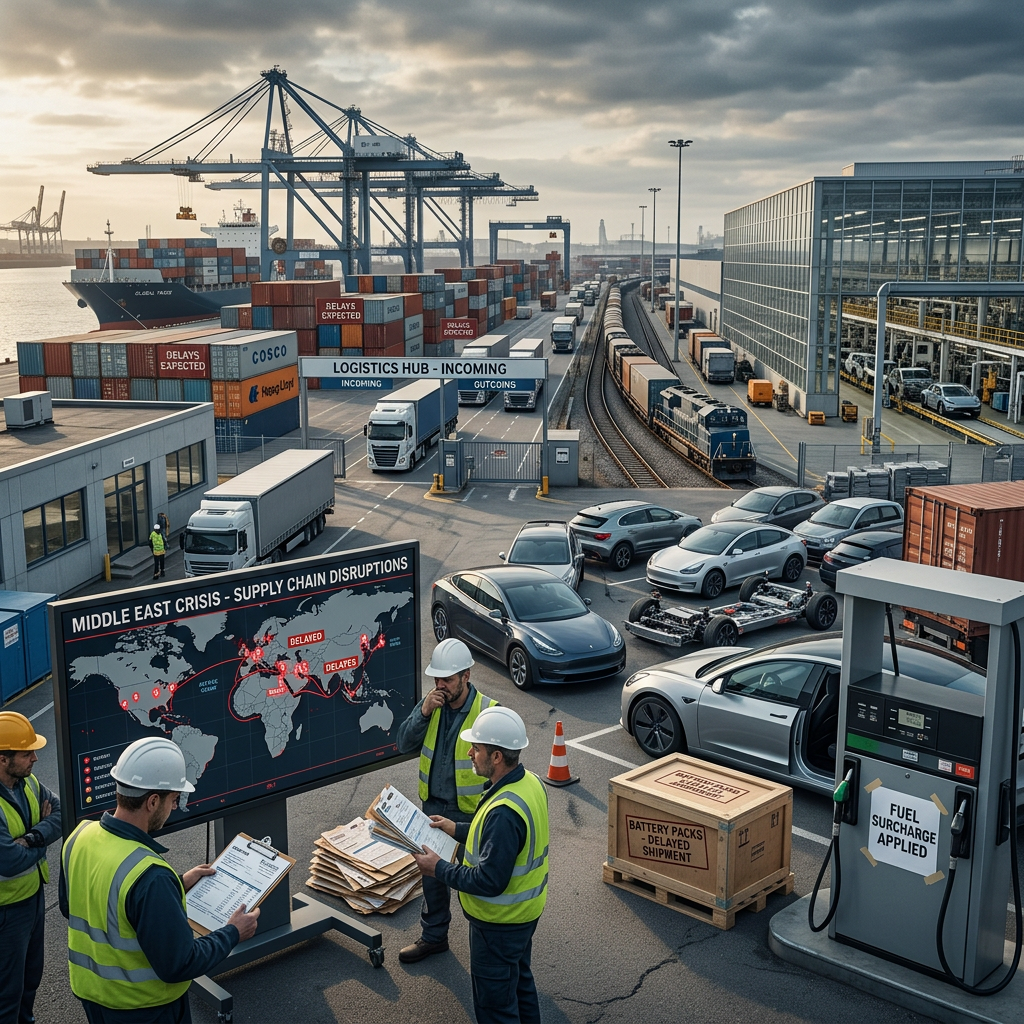
The shift from cost volatility to cost structure
In the initial phase of the disruption, the impact was visible in crude oil markets. Prices reacted quickly and then stabilized at elevated levels. By late March, the shock had moved beyond oil into LNG and petrochemicals, creating second-order effects across the automotive value chain.
Energy is now influencing vehicle economics at multiple levels. Manufacturing costs are rising due to higher electricity and gas prices. Supplier costs are increasing as energy-intensive processes such as metals refining and component production become more expensive. Logistics costs are expanding due to fuel prices, insurance premiums, and rerouting. The result is not just inflation. It is structural repricing. Vehicle programs that were viable under previous cost assumptions are now being reassessed. Margins are tightening, and cost pass-through is becoming more difficult in price-sensitive segments. This is particularly relevant in markets where demand elasticity is already under pressure.
EV economics under pressure
The impact is most pronounced in electric vehicles.
Battery production is highly sensitive to energy inputs. Electricity and gas costs directly influence cell manufacturing, making EV cost structures more exposed to energy volatility than internal combustion vehicles. As energy prices rise and remain unstable, the economics of EV platforms begin to shift. At the same time, supply chain variability is increasing risk around large-scale EV investments. Gigafactory economics, platform rollouts, and capacity expansion decisions are all being reassessed in the context of uncertain input costs and supply reliability.
This creates a tension within the mobility transition. Electrification continues to be a strategic priority, but the path to scale is becoming less predictable.
Supply chains are not breaking, they are becoming unpredictable
Automotive supply chains have not collapsed. Components continue to move, and production continues across regions. However, the system is losing predictability.
Transit times are extending. Routing is becoming more complex. Variability is increasing across shipping, air cargo, and inland logistics. Even small delays in inbound components can disrupt synchronized production systems such as just-in-time and just-in-sequence manufacturing.
The impact is not immediate shutdown. It is gradual degradation. Production schedules become less reliable. Buffer requirements increase. Coordination complexity rises across suppliers and plants. The system absorbs the disruption, but at the cost of efficiency, working capital, and margin. This shift from predictability to variability is one of the most critical changes for mobility systems.
Logistics is emerging as the primary constraint
Through March, disruptions were interpreted as delays. By April, they are better understood as variability across timing, cost, and routing.
Shipping through the Strait of Hormuz continues, but under tighter controls and higher risk. Rerouting is increasing transit distances. Insurance premiums are adding cost layers. Air cargo networks are experiencing capacity constraints and scheduling disruptions. For automotive supply chains, which depend on tightly sequenced flows, this creates disproportionate impact. Working capital is getting locked in transit. Delivery timelines are becoming uncertain. Production systems are being forced into continuous adjustment rather than planned optimization.
The constraint is no longer movement. It is coordination.
Materials and upstream dependencies are tightening
Energy disruption is also affecting upstream materials critical to automotive manufacturing.
Aluminum supply is tightening due to production constraints and export disruptions in the Middle East. Battery materials and semiconductor flows, many of which depend on stable global routing systems, are experiencing delays. However, the critical issue is not just availability. It is substitution. Automotive supply chains are not easily flexible. Supplier requalification cycles can extend from six to eighteen months for critical components. This limits the ability to quickly shift sourcing in response to disruption.
As a result, exposure is locked in the system. Procurement strategies based purely on cost are no longer sufficient. Compatibility, qualification timelines, and integration complexity now define supply continuity.
Planning models are under stress
Automotive production systems rely on stable inbound flows and predictable demand signals. Both are weakening.
OEMs are adjusting production plans in response to supply variability and demand uncertainty in affected regions. At the same time, inbound supply constraints are reducing confidence in production schedules across global operations. Traditional planning models are becoming less effective. Fixed schedules and long forecasting cycles are giving way to continuous adjustment and shorter decision windows. This is not a temporary deviation. It is a change in how mobility systems operate under sustained uncertainty.
Investment decisions are slowing
The mobility sector entered 2026 with strong momentum around electrification, software-defined vehicles, and capacity expansion. Since early March, that momentum has moderated.
Rising energy costs are distorting EV economics. Supply chain uncertainty is increasing risk around new investments. As a result, OEMs and suppliers are delaying decisions on platforms, plants, and expansion. This delay has strategic consequences.
Competitive advantage in mobility is increasingly driven by software integration, platform control, and scale execution. Slowing investment does not pause competition. It shifts relative positioning.
From efficiency to resilience
The current disruption is exposing a structural shift in mobility systems.
Models optimized for efficiency perform well under stable conditions. Under variability, they degrade quickly. Systems designed with flexibility, redundancy, and adaptability are more resilient. The shift is already underway. Mobility is moving from synchronized efficiency toward engineered resilience. This includes diversification of supply routes, rebalancing of supplier networks, and adjustments in production strategies.
However, not all resilience strategies are economically viable. The challenge is not just to build resilience, but to do so without eroding competitiveness.
The strategic inflection point
This is not a disruption to manage. It is a system to reassess.
The Gulf energy crisis and the broader Middle East conflict have introduced a new operating environment for automotive and mobility players. Energy is no longer just a cost input. Logistics is no longer just a function. Materials are no longer just procurement decisions. They are all becoming strategic variables. The key question for leadership teams is not whether conditions will normalize, but whether the current system design can operate effectively under sustained variability.
What mobility leaders need to reassess now
Leaders need to reassess three areas in parallel.
1. Supply chain exposure at the component and route level. Dependencies on constrained corridors and energy-intensive inputs must be clearly understood.
2. Platform and portfolio viability under sustained cost pressure. Not all vehicle programs will remain competitive in this environment.
3. Capital allocation and investment timing. Decisions must reflect current uncertainty rather than historical assumptions of stability.
4. Retest the capital plan against structural premiums, not just current prices.
The ability to act early, rather than react late, is becoming the defining advantage.
The system is not breaking. It is bending. But that bending is enough to reset cost structures, disrupt supply chain assumptions, and challenge the economics of mobility, particularly in EVs.
The Gulf energy crisis is not just affecting energy markets. It is redefining how automotive systems operate.
The future of mobility will not be determined by how quickly the system returns to normal, but by how effectively leaders adapt to a new baseline where energy, logistics, and supply chains are inherently less predictable. The window to respond is already narrowing.


How FutureBridge helps leadership teams act
In mobility, the challenge is not identifying disruption. It is prioritizing where it matters first and acting accordingly.
We support leadership teams in identifying exposure across vehicle programs, supplier networks, software architectures, and capital allocation. We assess where assumptions are no longer holding across electrification pathways, platform strategies, sourcing resilience, and demand outlooks and benchmark competitive positioning beyond surface signals.
We translate this into clear decisions of where to recalibrate investments, re-sequence programs, and protect or redeploy capital. Most importantly, we help distinguish short-term volatility from structural shifts, so decisions are taken at the right time, on the right issues.