

Grid Resiliency vs Reliability and how the distinction impacts power utility margins
Most utility executives use reliability and resilience interchangeably. This habit, more than any technology or regulatory gap, is quietly eroding margins across utilities in North America, Europe, and Asia Pacific.
This is not a semantic issue. It is a financial one. With electricity demand set to double by 2050, aging infrastructure under strain, and extreme weather becoming more frequent, the cost of this confusion is rising each year.
Here is what the distinction means, why it matters to the P&L, and how leading utilities are responding.
What does grid reliability mean, and why is it no longer enough?
Reliability is the grid’s ability to deliver power consistently under normal conditions. It answers a simple question: will electricity be available when everything works as expected?
Over time, the industry has defined reliability through standards such as NERC and IEEE 1366, using metrics like SAIDI, SAIFI, and CAIDI to measure outage frequency and duration under expected conditions and to guide compliance and investment.
The limitation:
Reliability is built on averages and often excludes Major Event Days, the very disruptions that matter most. A utility can report strong headline performance while customers face extended outages during severe events that never show up in core metrics.
What does grid resilience mean, and why does it matter now?
Resilience is the grid’s ability to anticipate, absorb, and recover from high-impact events beyond normal operations. While reliability asks whether the system will perform under expected conditions, resilience focuses on how severe the impact will be when disruptions occur and how quickly the system can recover.
Recent events highlight why this distinction matters. The 2025 Iberian blackout caused the sudden loss of around 15 GW of capacity and contributed to a near day-long disruption across the Iberian grid.
In Europe, heatwaves have pushed daily electricity demand sharply higher in some markets, while outages at thermal and nuclear plants amplified price spikes.
In the U.S., grid stress is intensifying as utilities try to balance aging infrastructure, electrification, and more volatile operating conditions.
These are no longer rare events. They define the operating environment. Yet resilience is not governed by metrics like SAIDI or SAIFI and often struggles to secure investment in utility planning cycles.
Reliability vs resilience: what executives need to separate
Both are necessary. Neither replaces the other. The strategic error is treating strong reliability scores as evidence of resilience readiness.
Reliability measures normal conditions. Today’s grid no longer operates within that baseline.
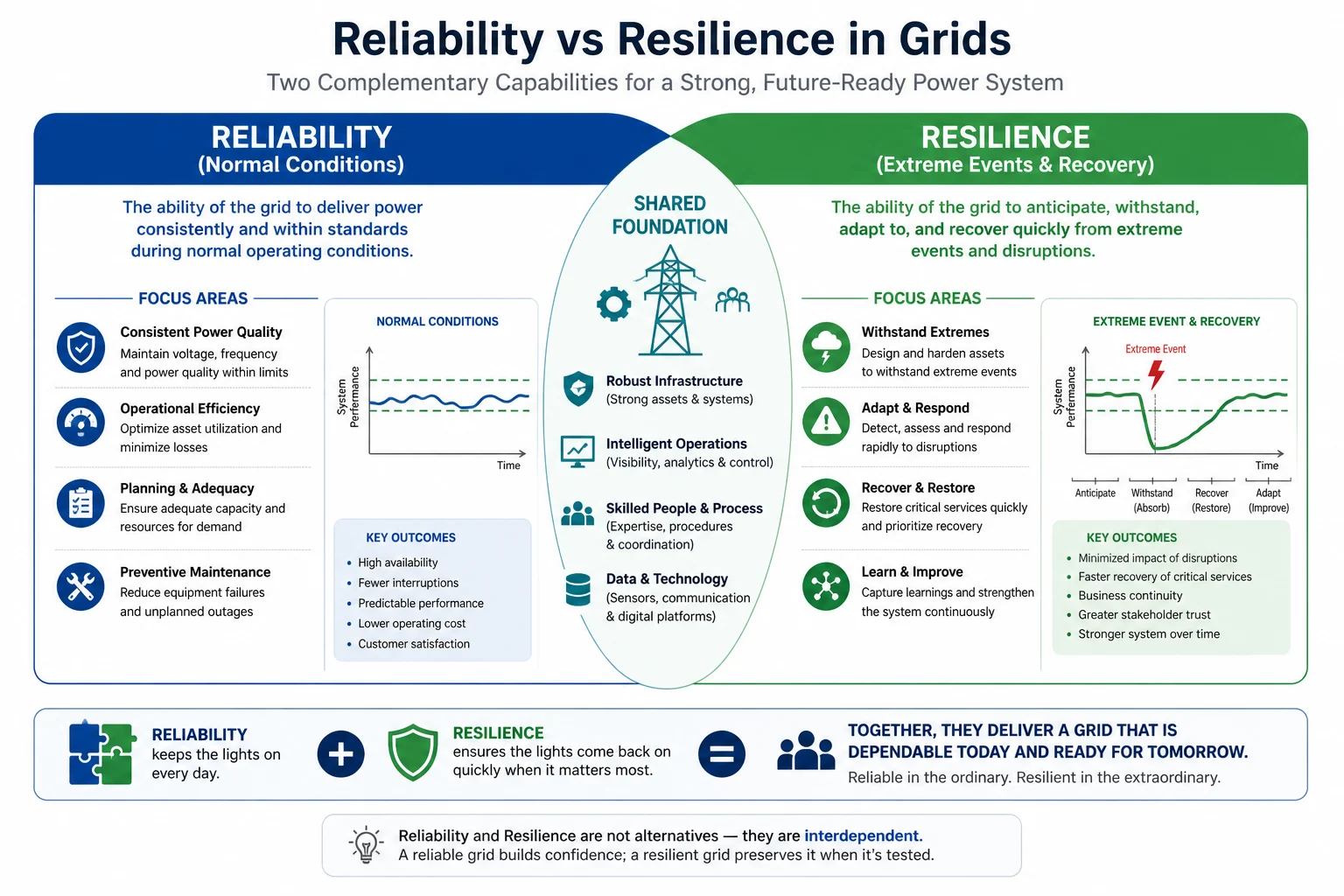
In practice, this means:
- Reliability asks: will the system perform under normal conditions?
- Resilience asks: how severe is the impact, and how fast is recovery when the system is stressed?
- Reliability is anchored in standards and averages; resilience is about outliers, extremes, and recovery paths.
- The gap between them is where the most expensive failures and margin shocks live.
The traditional power utility model was built for predictable demand, dispatchable generation, and assets operating within known limits. That world is gone. Utilities that still treat reliability and resilience as interchangeable are effectively managing yesterday’s grid in tomorrow’s risk environment.
Frequently Asked Questions
Q. What is the difference between grid reliability and grid resilience?
Reliability measures performance under normal operating conditions, while resilience measures how the grid anticipates, absorbs, and recovers from severe disruptions.
Q. What does grid flexibility mean?
Grid flexibility is the ability to make existing power system capacity respond faster, smarter, and more reliably under changing operating conditions.
Q. How do EVs contribute to grid flexibility?
EVs can act as flexible load and, in some cases, distributed storage, helping utilities manage demand peaks and renewable variability more efficiently.
Q. Can existing grids meet future electrification needs without major CAPEX?
Utilities can unlock more capacity from existing grids through flexibility, storage, forecasting, demand response, and smarter digital operations before major CAPEX becomes unavoidable.