Smarter Scent, Verified Sustainability, and the Race to Scale
For years, fragrance innovation has largely been a pursuit of longevity. How do we make scent last longer, survive the wash, and deliver that familiar moment of freshness when consumers expect it? That question still matters. But it is no longer enough.
The industry is entering a more demanding phase, where fragrance performance must be considered alongside material efficiency, environmental responsibility, regulatory readiness, and the economics of delivering a consistent consumer experience.
This creates a difficult balancing act. A capsule that protects fragrance exceptionally well may struggle to meet degradation requirements. A promising biodegradable alternative may not survive the formulation or rinse cycle. And a technology that performs beautifully in the laboratory may become commercially unviable when manufacturing complexity and cost enter the equation.
From Lasting Fragrance to Precision Delivery
Fragrance delivery is evolving from extending scent longevity to controlling where fragrance deposits, when it releases, and how much material delivers the desired experience.
Encapsulation protects volatile ingredients against evaporation and formulation interactions, enabling scent release during wear, touch, or movement rather than losing fragrance during washing.
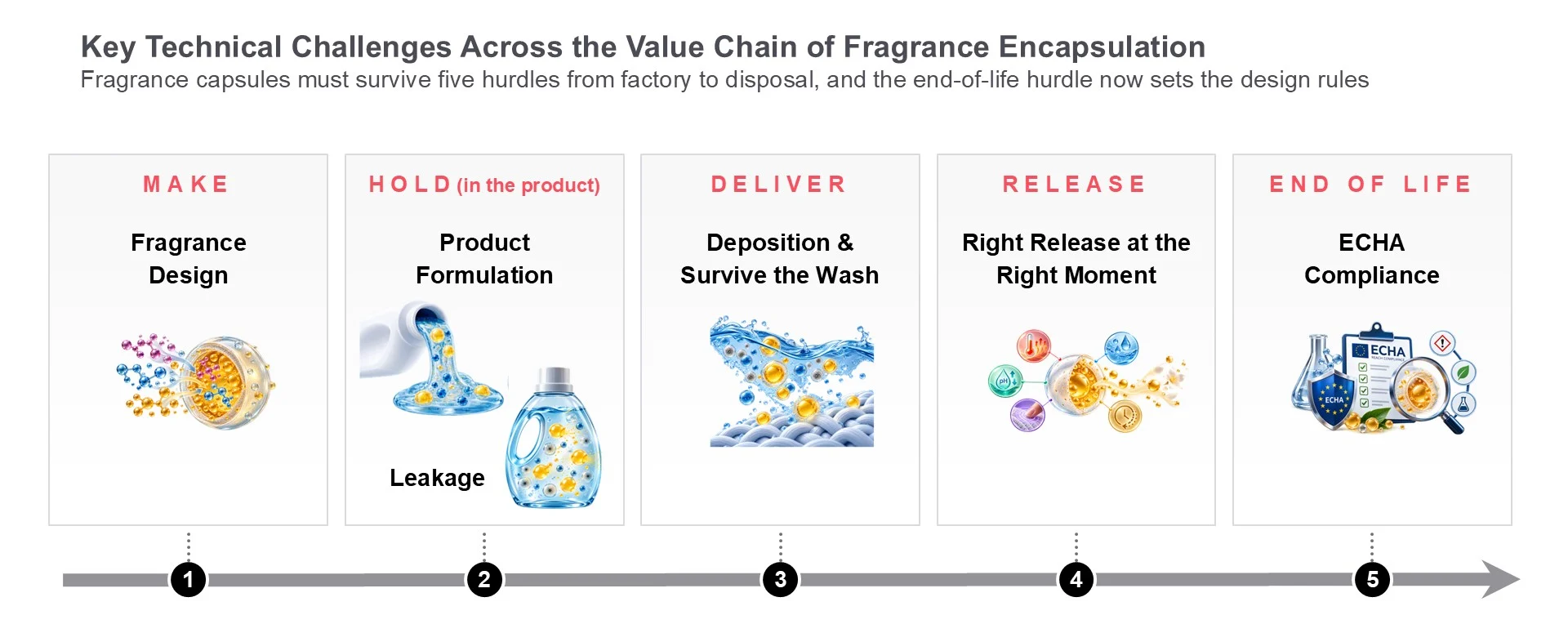
A successful system must protect fragrance in the bottle, retain it through rinsing, release it during use, and meet end-of-life requirements; failure at any stage limits formulation value.
Regulation is Redesigning the Technology Landscape
EU Regulation 2023/2055 sets 17 October 2029 as the application date for restrictions on synthetic polymer microparticles used in fragrance encapsulation, subject to applicable exclusions and derogations.
Qualifying degradable polymers, eligible unmodified natural polymers, and polymers without carbon atoms in their structure offer distinct routes outside the restricted definition.
Reducing restricted material below the applicable concentration threshold is a separate strategy; it does not make that material inherently biodegradable.
A positive biodegradation result for a complete capsule slurry does not establish compliance for every relevant wall polymer; supplier qualification requires polymer-specific evidence and defensible sample preparation.
Material Innovation Meets the Performance Barrier
Protein and polysaccharide shells use pea protein, gelatin, chitosan, or cellulose derivatives, but final degradability depends on chemical modification and crosslinking.
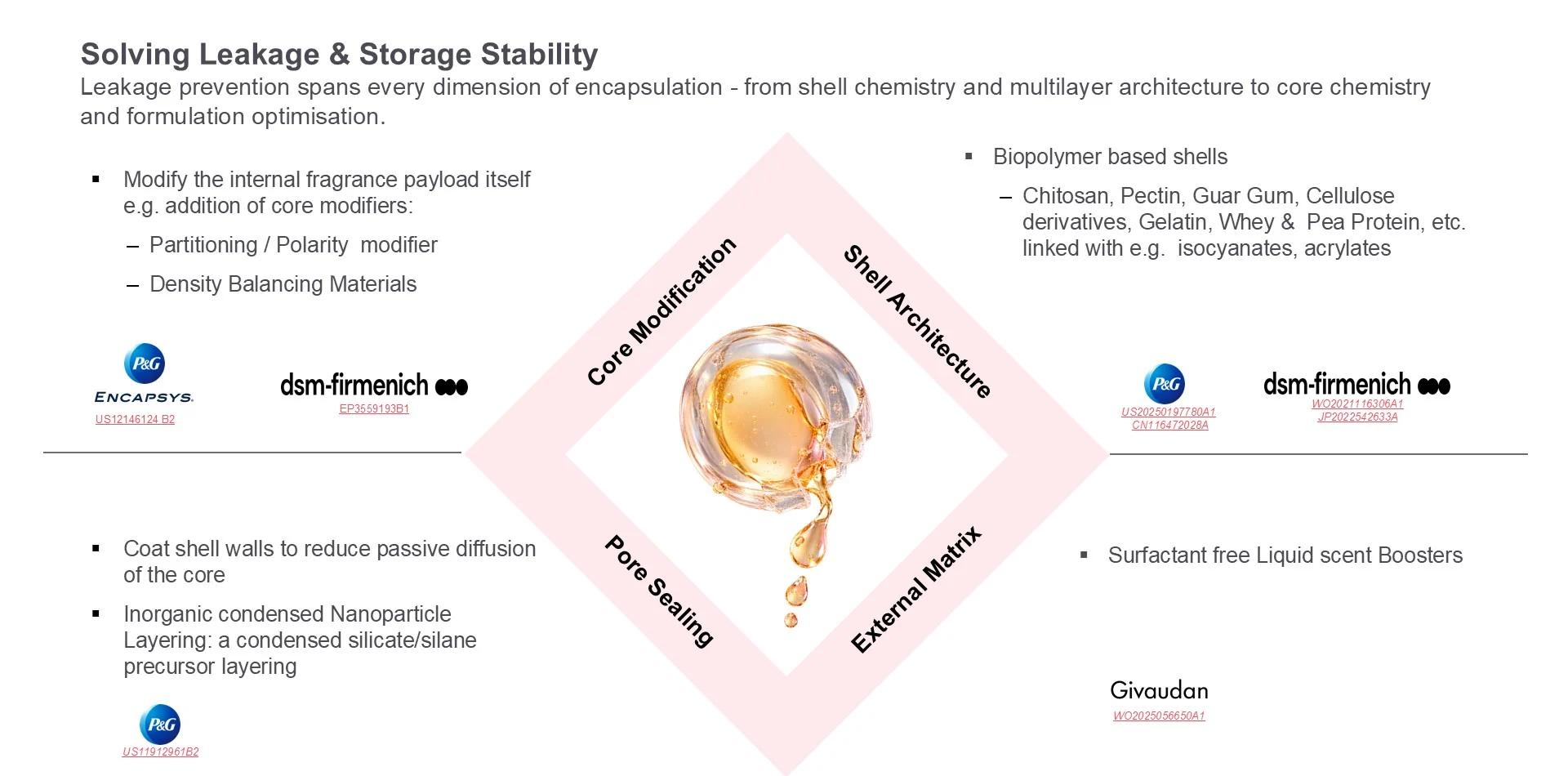
Leakage control requires coordinated changes to the fragrance core, shell architecture, barrier layers, and surrounding formulation; strengthening the shell alone can compromise degradability.
Silica and mineral systems provide alternatives to conventional organic polymer walls, although brittleness, permeability, and synthesis time can limit practical performance.
Surface charge, adhesion chemistry, capsule shape, and formulation coacervates influence retention during rinsing; Givaudan’s PlanetCaps and DSM-Firmenich’s Popscent Eco Max illustrate commercial development of degradable delivery.
Fragrance compaction uses high-impact ingredients to lower dosage and potentially reduce shell-material consumption, although concentrated formats remain more challenging.
Broader Delivery Options and Safety Requirements
Cyclodextrins host suitable fragrance molecules within molecular cavities, while pro-fragrances release chemically bound scent through selected reactions; molecular fit and trigger chemistry determine application suitability.
Biodegradability does not establish human safety: residual crosslinkers, fragrance allergens, degradation products, and potentially inhalable material in sprays need separate assessment.
EU Regulation 2023/1545 expands individual fragrance-allergen labeling, retaining declaration thresholds of 0.001% in leave-on cosmetics and 0.01% in rinse-off cosmetics for listed allergens.
Sustainability Must Be Measured Beyond the Shell
Bio-based origin and laboratory biodegradability do not independently establish a lower environmental footprint.
Environmental fate assessment must track where capsule materials go after use, how long they persist, and what they become in wastewater, soil, and aquatic environments.
Wastewater treatment can transfer capsules into sludge rather than destroy them, making sludge disposal and potential soil exposure relevant.
Degradation rates depend on temperature, oxygen, and microbial activity; laboratory results do not automatically predict breakdown across real-world conditions.
Assessment should distinguish fragmentation from mineralization and evaluate the persistence and ecotoxicity of remaining materials and transformation products.
Lifecycle comparisons should use equivalent sensory performance, while claims of reduced washing require demonstrated changes in consumer behaviour.
Commercial Winners will prove value per dose
Technology selection should prioritize cost per effective dose, incorporating loading, deposition efficiency, manufacturing yield, and sensory performance rather than capsule price alone.
Comparable testing should measure storage leakage, post-rinse deposition, friction-triggered release, and sensory longevity under matched conditions; haircare additionally requires combability, residue, and hair-feel assessment.
Scale-up decisions must address batch consistency, equipment requirements, supplier capacity, and freedom to operate before committing to a chemistry platform.
Prioritize degradable delivery and compaction for near-term development, evaluate mineral and hybrid systems by application, and treat engineered proteins and triggered degradation as opportunities requiring further validation.
The winners will solve the whole delivery system
The fragrance industry does not have a shortage of promising technologies. What it needs now is greater clarity on which of those technologies can make the transition from formulation success to dependable commercial performance. Biodegradable shells, mineral alternatives, molecular delivery systems, and fragrance compaction each offer different routes forward. None provides a universal answer. Their value will depend on the application, the fragrance chemistry, the formulation environment, and ultimately the experience delivered to the consumer.
For business leaders, the question is shifting from which encapsulation technology works best? to which delivery system can deliver the right sensory experience, withstand regulatory scrutiny, and scale at an acceptable cost? That distinction matters. It changes how companies prioritize R&D, qualify suppliers, evaluate partnerships, and decide where to invest. So, a lower-cost capsule is not necessarily a more economical solution. A biodegradable material is not automatically a more sustainable one. And a technically impressive delivery mechanism does not create business value unless it can be manufactured reliably, integrated into existing formulations, and justified by its performance. The commercial benchmark should therefore move toward value per effective dose and how much fragrance, material, manufacturing effort, and cost are required to deliver a measurable sensory benefit.
That shift will influence more than product development. It will reshape supplier relationships, technology partnerships, investment priorities, and the competitive positioning of fragrance and consumer goods companies. Regulation is accelerating this transition, but it should not be the only reason to act. Companies that treat the challenge purely as material substitution risk missing a broader opportunity to rethink how fragrance is designed, delivered, measured, and monetized.
The next generation of fragrance delivery will be defined not by the most sophisticated chemistry, but by the companies that turn responsible innovation into repeatable commercial value.