The Future of AI – Consolidation, Competition, and First-Mover Advantages
Executive Summary
AI competition is moving beyond the race to build larger models. Tech majors are increasingly competing across the full AI stack, from chips, computing infrastructure, and data to foundation models, cloud platforms, enterprise applications, and distribution. Large-scale investments in data centers, GPUs, and power infrastructure reflect how access to compute and capital is becoming a strategic advantage as AI adoption scales.
Meanwhile, AI models are becoming more capable, efficient, and accessible. Multimodal and reasoning models are expanding the complexity of tasks AI can perform, smaller and domain-specific models are bringing advanced capabilities into enterprise and on-device environments, and agentic AI is moving applications beyond generating responses toward executing and coordinating workflows.
This evolution is also changing how AI is consolidating industries. At the infrastructure and foundation-model layers, high development costs and economies of scale are strengthening a relatively small number of well-capitalized technology ecosystems. At the application layer, however, falling model costs and wider access are enabling more specialized, industry-specific solutions. Consolidation is therefore taking place not only through acquisitions, but through strategic investments, partnerships, infrastructure dependencies, talent acquisition, and control over critical parts of the AI value chain.
For enterprises, this is changing the nature of first-mover advantage in AI. Early access to a model is unlikely to remain differentiating for long as comparable capabilities become widely available. More durable advantages could come from integrating AI into proprietary data, workflows, products, and decision-making early enough to build organizational learning and capabilities that competitors cannot replicate simply by accessing the same models.
The next phase of AI competition is therefore likely to be defined less by who has access to AI and more by who controls critical parts of its ecosystem, who can translate rapidly evolving capabilities into measurable business value, and who can build differentiated applications around proprietary industry knowledge.
AI Growing Smarter Day-by-day
AI technologies fundamentally rely on three interconnected pillars: hardware, data, and models. From the inception of AI with a self-learning game in 1952 (Machine Learning the Game of Checkers) to today’s advanced foundation models, progress across these areas has continuously expanded what AI systems can do. Modern AI combines increasingly powerful computing infrastructure with multimodal data, sophisticated model architectures, and more efficient training and inference techniques.
The nature of that progress is also changing. AI development is moving beyond improvements in individual tasks such as language understanding, text summarization, and image classification toward systems capable of reasoning across modalities, processing text, images, audio, and video, and interacting with tools and software environments. Smaller and domain-specific models are simultaneously making advanced AI more accessible for enterprise and on-device applications.
Agentic AI represents another emerging step in this evolution. Rather than simply responding to prompts, AI systems are increasingly being developed to plan tasks, use tools, retrieve information, and coordinate actions across workflows. Multi-agent architectures could extend this further by enabling specialized AI agents to collaborate on more complex business and industrial processes.
As capabilities converge, traditional AI benchmarks alone may provide an increasingly incomplete view of competitive performance. Reliability, reasoning, cost, latency, domain performance, security, and the ability to integrate AI into real-world workflows are becoming equally important measures of whether a model can create practical business value.
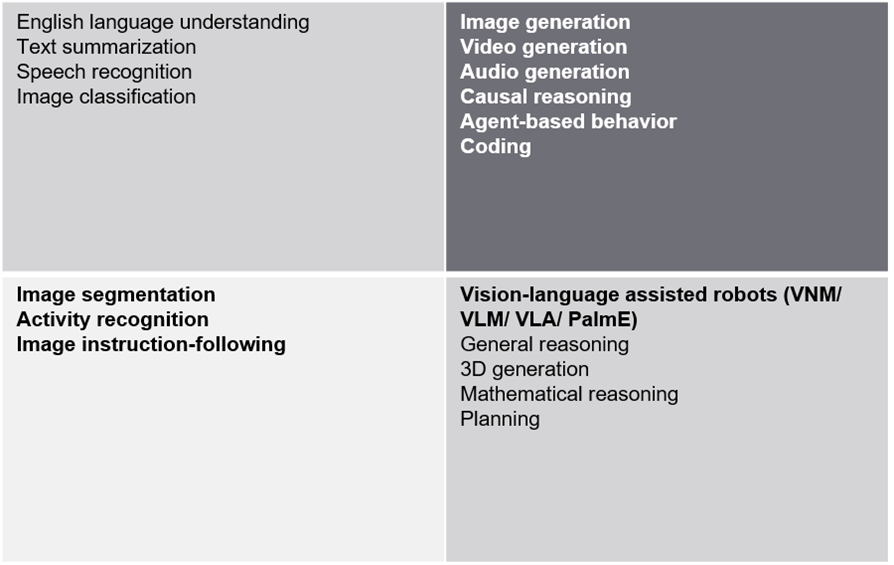
In the competitive AI landscape, benchmarks remain important for comparing model capabilities, but performance is becoming harder to judge through standardized tests alone. As leading models converge on established benchmarks, enterprises are placing greater weight on reasoning, reliability, inference cost, latency, security, domain-specific performance, and the ability to operate effectively within real-world workflows.
AI is now at a different inflection point. Competition is extending beyond model performance into the infrastructure and ecosystems required to deploy AI at scale. Access to GPUs, data centers, energy, proprietary data, and distribution is concentrating influence among well-capitalized players, while falling inference costs, smaller models, and open-weight alternatives are expanding opportunities further down the AI stack.
Enterprise adoption is evolving as well. The focus is shifting from experimenting with standalone GenAI tools toward embedding AI into core workflows, products, and decision-making. Agentic AI and increasingly capable reasoning models are accelerating this transition, but the central challenge for leaders is becoming more commercial: identifying where AI can deliver measurable value, which capabilities should be built or bought, and which technology partners can support deployment at scale.
This creates a more complex competitive landscape. AI consolidation is occurring across infrastructure, foundation models, cloud platforms, and enterprise software, while specialized applications continue to emerge across industries. The first-mover advantage is therefore becoming less about adopting the newest model first and more about building proprietary data, workflow integration, organizational learning, and domain capabilities that can compound as the underlying technology evolves.
The following trends examine some of the forces shaping this next phase of AI. For the broader landscape, explore the ‘Trends Radar’ in the ‘Future of AI’ report.
Increasing AI Funding Amid Profitability Concerns
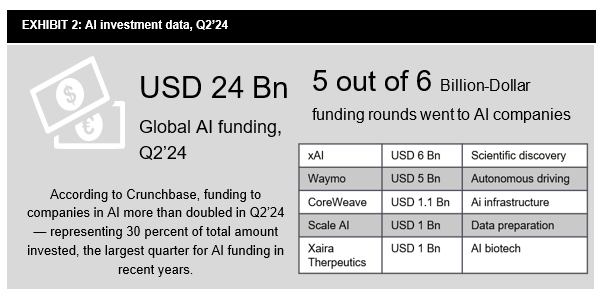
AI investment is entering a more selective phase. Capital continues to flow into foundation models, compute infrastructure, data centers, and high-potential AI applications, but the economics of developing and operating advanced models are increasing pressure to demonstrate sustainable returns. At the same time, acquisitions, strategic investments, talent deals, and partnerships are drawing parts of the AI ecosystem closer to large technology platforms. This is creating a two-speed market: greater consolidation around capital-intensive infrastructure and foundation models, alongside growing competition in specialized, industry-specific applications.
From GenAI-Assisted to Agentic Workforce
Enterprise AI is moving beyond copilots that generate content, summarize information, or assist with individual tasks. More capable reasoning models and AI agents are beginning to plan, execute, and coordinate multi-step workflows across software development, customer service, marketing, research, finance, and other knowledge-intensive functions.
This shift will not affect every sector equally. Software, financial and professional services, customer operations, and other information-intensive industries face more immediate disruption because significant parts of their workflows are already digital. In manufacturing, healthcare, mobility, and other physical or highly regulated sectors, adoption will increasingly depend on how effectively AI can integrate with domain data, robotics, operational systems, and human oversight.
The workforce impact is therefore likely to extend beyond task automation. As AI takes on more execution-oriented activities, human roles could shift toward judgment, exception management, supervision, and higher-value decision-making. For enterprises, the first-mover advantage will increasingly come from learning how to redesign workflows around AI, build proprietary data and organizational capabilities, and scale successful use cases before those practices become commonplace.
Multimodal AI Evolves Towards Agentic and Physical Intelligence
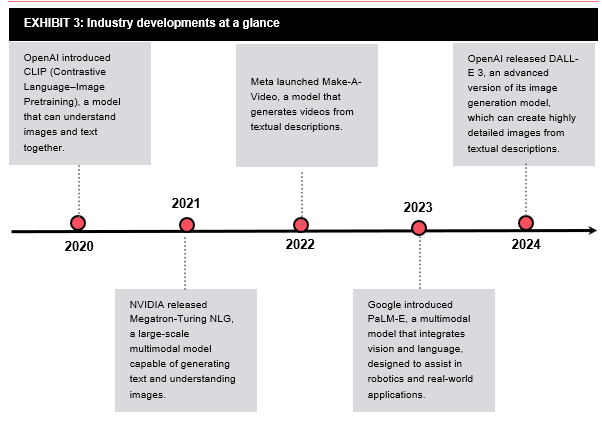
Multimodal AI is evolving beyond combining text, images, audio, and video. Newer systems are increasingly able to reason across these inputs, interact with tools, and translate multimodal understanding into actions. This is expanding applications across healthcare, retail, manufacturing, mobility, and customer operations, while creating a foundation for agentic and physical AI systems that can operate across digital and real-world environments.
Tracking signals for monitoring new developments
The AI landscape is now advancing across multiple interconnected technology layers. Reasoning models, AI agents and multi-agent systems, world models, robotic foundation models, smaller domain-specific models, and advances in AI infrastructure are emerging as important signals of where capabilities and industry applications could move next.
For businesses, tracking these signals is becoming increasingly important as AI disruption will not occur uniformly across industries. Sectors with highly digitized workflows and large volumes of accessible data may experience faster change, while manufacturing, mobility, healthcare, and other physical or regulated industries will depend more heavily on advances in robotics, multimodal intelligence, domain-specific models, and system integration. Monitoring these signals can therefore provide an early indication of where AI capabilities are moving from experimentation toward commercially relevant applications.
Below are some of the prominent AI signals to watch. The detailed ‘Future of AI’ report maps 40 signals, including 16 critical signals explored in greater depth.
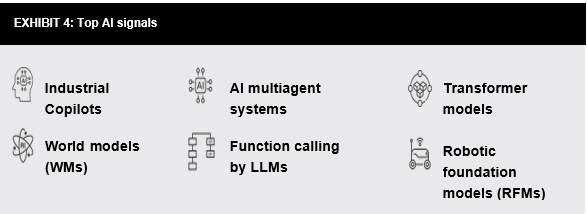
AI R&D is shifting from simply scaling models toward improving reasoning, efficiency, autonomy, and real-world execution. Advances in reasoning models, reinforcement learning, multimodal architectures, and tool use are expanding what AI systems can accomplish. At the same time, standalone GenAI tools are giving way to agentic and multi-agent systems capable of planning tasks, interacting with enterprise software and data, and coordinating increasingly complex workflows.
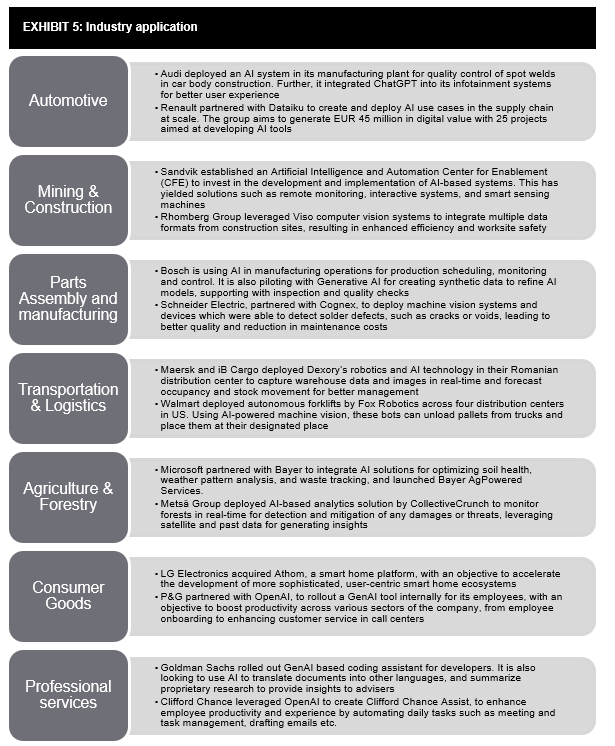
Applications Across Sectors
AI disruption is accelerating across industries, but its impact and pace vary considerably by sector. Software, financial and professional services, marketing, customer operations, and other information-intensive sectors face more immediate change because large parts of their workflows are already digitized and can be augmented or automated by AI. Healthcare, life sciences, manufacturing, mobility, and other physical or regulated industries also offer significant potential, but adoption depends more heavily on domain-specific data, system integration, robotics, safety, and regulation.
As advanced models become more accessible, competitive advantage is shifting from simply adopting AI to integrating it into high-value workflows. Organizations that connect AI with proprietary data, domain expertise, and operating processes can build learning advantages that become harder to replicate as adoption scales. The sectors facing the greatest disruption will therefore be those where AI can move beyond isolated use cases to reshape core workflows, products, and business models.
AI’s Journey: From Experimentation to Enterprise Advantage
AI is moving beyond the experimentation phase. The next three to five years will be defined less by access to increasingly capable models and more by how effectively businesses translate those capabilities into measurable operational and commercial value. As AI becomes embedded across enterprise software, workflows, products, and decision-making, the competitive question is shifting from “Where can we use AI?” to “Where can AI create an advantage that is difficult to replicate?”
This transition is also reshaping the AI market. Compute-intensive infrastructure and foundation models increasingly favor well-capitalized ecosystems, while falling model costs and wider access are creating opportunities for specialized, domain-specific applications. For enterprises, this creates a more complex build-versus-buy landscape: choosing where to rely on external AI platforms, where proprietary data and capabilities matter, and where deeper integration can create differentiated value.
The first-mover advantage in AI is therefore becoming less about adopting the newest model first and more about learning faster. Businesses that successfully embed AI into high-value workflows can begin building proprietary data, organizational capabilities, redesigned processes, and AI-enabled customer experiences that compound over time. The next phase of AI competition will be shaped by who can scale these advantages while managing cost, governance, security, and growing dependence on a consolidating technology ecosystem.
Key Questions for Business Leaders
Where can AI create the greatest business value?
The strongest opportunities are increasingly found where AI can improve or redesign high-value workflows rather than automate isolated tasks. Priority areas include:
- Increasing productivity and reducing process costs
- Improving the speed and quality of decision-making
- Redesigning customer and employee experiences
- Accelerating R&D and product development
- Creating new AI-enabled products, services, and business models
Should enterprises build, buy, or partner for AI capabilities?
The decision depends largely on where AI creates differentiation:
- Buy standardized capabilities already available through established platforms
- Build where proprietary data, domain knowledge, or workflows create competitive advantage
- Partner where specialized expertise or infrastructure can accelerate deployment
- Assess interoperability, data ownership, switching costs, and vendor dependency before scaling
What is the first-mover advantage in enterprise AI?
The advantage is increasingly about learning first rather than simply adopting first. Early deployment in strategically relevant workflows can help businesses:
- Build proprietary data and feedback loops
- Develop AI-specific organizational capabilities
- Redesign processes around human-AI collaboration
- Identify successful use cases before competitors
- Turn accumulated learning into an advantage that becomes harder to replicate
How does AI industry consolidation affect enterprise buyers?
Consolidation across chips, cloud infrastructure, foundation models, and enterprise software can provide integrated capabilities, but it also introduces strategic dependencies. Enterprises increasingly need to consider:
- Vendor and platform concentration
- Interoperability between models and enterprise systems
- Data ownership and portability
- Switching costs and potential vendor lock-in
- Long-term flexibility as models and platforms evolve
How can businesses move from AI pilots to scaled adoption?
Scaling requires more than a successful proof of concept. Key foundations include:
- Clear business ownership and measurable outcomes
- Reliable, accessible, and governed enterprise data
- Integration into existing workflows and technology systems
- Workforce skills and redesigned operating processes
- Security, governance, and human oversight appropriate to the use case
The strategic challenge is no longer identifying whether AI will matter, but understanding where it will reshape competitive advantage and where investment can translate into defensible business value. For a broader view of the technologies, signals, and industry implications shaping this transition, explore our full report on The Future of AI.
Explore how emerging AI capabilities could reshape your markets, operating model, and competitive landscape – Connect with FutureBridge.